



Predictive Utility of an Adapted Marshall Head-CT Classification Scheme After Traumatic Brain Injury
Supporting Files

-
January 19 2019
-
File Language:
English
Details
-
Alternative Title:Brain Inj
-
Personal Author:
-
Description:Objective:
To study the predictive relationship among persons with traumatic brain injury (TBI) between an objective indicator of injury severity (the adapted Marshall computed tomography [CT] classification scheme) and clinical indicators of injury severity in the acute phase; functional outcomes at inpatient rehabilitation discharge; and functional and participation outcomes at 1 year after injury, including death.
Participants:
The sample involved 4,895 individuals who received inpatient rehabilitation following acute hospitalization for TBI and were enrolled in the Traumatic Brain Injury Model System National Data Base between 1989 and 2014.
Design:
Head CT variables for each person were fit into adapted Marshall CT classification categories I through IV.
Main Measures:
Prediction models were developed to determine the amount of variability explained by the CT classification categories compared with commonly used predictors, including a clinical indicator of injury severity.
Results:
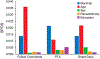
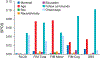
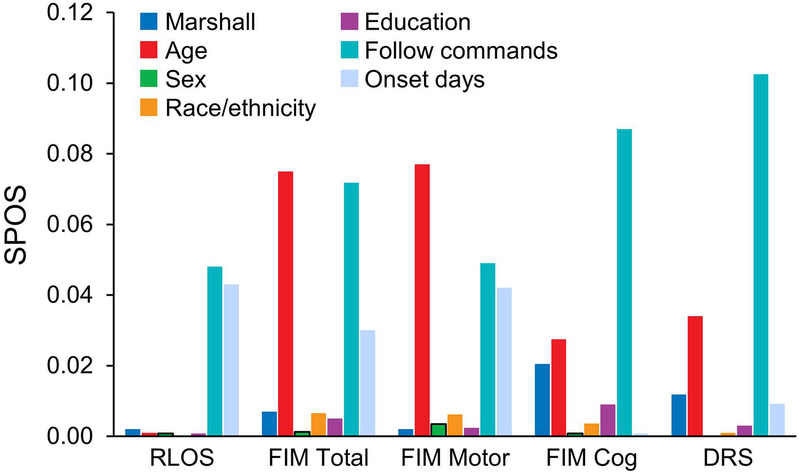
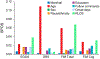
The adapted Marshall classification categories aided only in the prediction of craniotomy or craniectomy during acute hospitalization, otherwise making no meaningful contribution to variance in the multivariable models predicting outcomes at any time point after injury.
Conclusion:
Results suggest that head CT findings classified in this manner do not inform clinical discussions related to functional prognosis or rehabilitation planning after TBI.
-
Subjects:
-
Source:Brain Inj. 33(5):610-617
-
Pubmed ID:30663426
-
Pubmed Central ID:PMC6436993
-
Document Type:
-
Funding:U48 DP000045/DP/NCCDPHP CDC HHS/United States ; U48 DP000034/DP/NCCDPHP CDC HHS/United States ; U48 DP000030/DP/NCCDPHP CDC HHS/United States ; 90DP0060/ACL/ACL HHS/United States ; 90DP0033/ACL/ACL HHS/United States ; 90DP0036/ACL/ACL HHS/United States ; U48 DP000046/DP/NCCDPHP CDC HHS/United States ; 90DP0046/ACL/ACL HHS/United States ; 90DP0030/ACL/ACL HHS/United States ; U48 DP000036/DP/NCCDPHP CDC HHS/United States ; 90DP0038/ACL/ACL HHS/United States ; 90DP0039/ACL/ACL HHS/United States ; 90DP0045/ACL/ACL HHS/United States ; 90DP0037/ACL/ACL HHS/United States ; U48 DP000033/DP/NCCDPHP CDC HHS/United States ; 90DP0034/ACL/ACL HHS/United States ; U48 DP000039/DP/NCCDPHP CDC HHS/United States ; U48 DP000060/DP/NCCDPHP CDC HHS/United States
-
Volume:33
-
Issue:5
-
Collection(s):
-
Main Document Checksum:urn:sha256:e9067efd4f83b84de965ba89e36500963dd5b404208a5ccdf9964cc211e0763a
-
Download URL:
-
File Type:
 [PDF
- 803.66 KB
]
[PDF
- 803.66 KB
]
Supporting Files


File Language:
English
 Was this page helpful?
 Found an issue?


CDC STACKS serves as an archival repository of CDC-published products including
scientific findings,
journal articles, guidelines, recommendations, or other public health information authored or
co-authored by CDC or funded partners.
As a repository, CDC STACKS retains documents in their original published format to ensure public access to scientific information.
As a repository, CDC STACKS retains documents in their original published format to ensure public access to scientific information.
You May Also Like
COLLECTION
CDC Public Access