



Vital Signs: Trends in Staphylococcus aureus Infections in Veterans Affairs Medical Centers — United States, 2005–2017
Supporting Files
Public Domain

-
March 08 2019
File Language:
English
Details
-
Alternative Title:Trends in Staphylococcus aureus Infections in Veterans Affairs Medical Centers — United States, 2005–2017
-
Journal Article:Morbidity and Mortality Weekly Report (MMWR)
-
Personal Author:
-
Description:Introduction
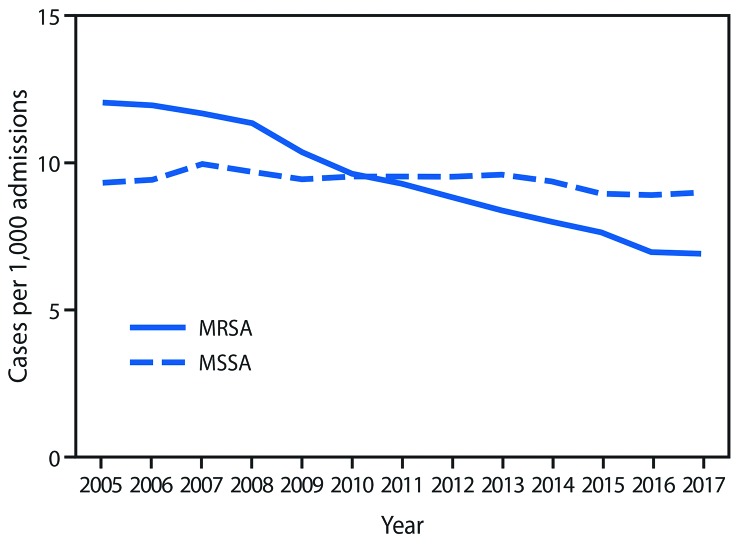
By 2007, all Department of Veterans Affairs medical centers (VAMCs) had initiated a multifaceted methicillin-resistant Staphylococcus aureus (MRSA) Prevention program. MRSA and methicillin-susceptible S. aureus (MSSA) infection rates among VAMC inpatients from 2005 to 2017 were assessed.
Methods
Clinical microbiology data from any patient admitted to an acute-care VAMC in the United States from 2005 through 2017 and Trends in hospital-acquired MRSA colonization were examined.
Results
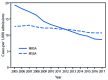
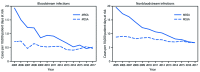
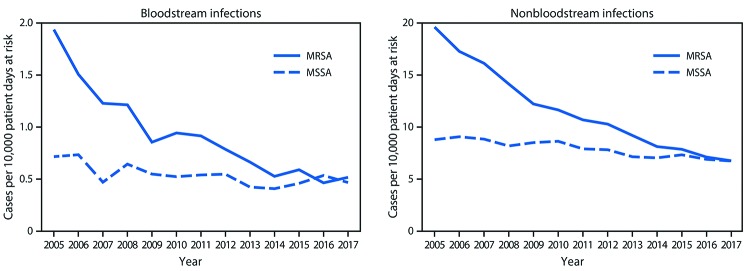
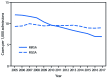
S. aureus infections decreased by 43% overall during the study period (p<0.001), driven primarily by decreases in MRSA, which decreased by 55% (p<0.001), whereas MSSA decreased by 12% (p = 0.003). Hospital-onset MRSA and MSSA infections decreased by 66% (p<0.001) and 19% (p = 0.02), respectively. Community-onset MRSA infections decreased by 41% (p<0.001), whereas MSSA infections showed no significant decline. Acquisition of MRSA colonization decreased 78% during 2008–2017 (17% annually, p<0.001). MRSA infection rates declined more sharply among patients who had negative admission Surveillance MRSA screening tests (annual 9.7% decline) compared with those among patients with positive admission MRSA screening tests (4.2%) (p<0.05).
Conclusions and Implications for Public Health Practice
Significant reductions in S. aureus infection following the VAMC intervention were led primarily by decreases in MRSA. Moreover, MRSA infection declines were much larger among patients not carrying MRSA at the time of admission than among those who were. Taken together, these results suggest that decreased MRSA Transmission played a substantial role in reducing overall S. aureus infections at VAMCs. Recent calls to withdraw infection control interventions designed to prevent MRSA Transmission might be premature and inadvisable, at least until more is known about effective control of bacterial pathogen Transmission in health care settings. Effective S. aureus Prevention strategies require a multifaceted approach that includes adherence to current CDC recommendations for preventing not only device- and procedure-associated infections, but also Transmission of health care–prevalent strains. -
Subjects:
-
Source:MMWR Morbidity Mortal Weekly Rep. 68(9):220-224
-
Series:
-
DOI:
-
ISSN:0149-2195 (print) ; 1545-861X (digital)
-
Pubmed ID:30845116
-
Pubmed Central ID:PMC6421970
-
Document Type:
-
Place as Subject:
-
Pages in Document:5 pdf pages
-
Volume:68
-
Issue:9
-
Download URL:
-
File Type:
 [PDF - 173.25 KB]
 -
Collection(s):
-
Main Document Checksum:urn:sha-512:d6a8940a13336c504141a279558532f98645100b23c6bc296d676a4d808ae0d2cc860b27679f0e8c50d0b66baebb380a90f8e57a62ef9af947ef74b4c984c7ce
Supporting Files


File Language:
English
 Was this page helpful?
 Found an issue?


CDC STACKS serves as an archival repository of CDC-published products including
scientific findings, journal articles, guidelines, recommendations, or other public health information authored or
co-authored by CDC or funded partners.
As a repository, CDC STACKS retains documents in their original published format to ensure public access to scientific information.
As a repository, CDC STACKS retains documents in their original published format to ensure public access to scientific information.
You May Also Like
COLLECTION
Morbidity and Mortality Weekly Report (MMWR)