


Vaccination differences among U.S. adults by their self-identified sexual orientation, National Health Interview Survey, 2013–2015
Supporting Files
Public Domain

-
March 07 2019
-
File Language:
English
Details
-
Alternative Title:PLoS One
-
Personal Author:
-
Description:Introduction
Very few studies have explored the associations between self-identified sexual orientation and comprehensive vaccination coverage. Most of the previous studies that reported health disparities among lesbian, gay and bisexual populations were not based on a nationally representative sample of U.S. adults, limiting the generalizability of the findings. Starting in 2013, the National Health Interview Survey (NHIS) included questions to ascertain the adult’s self-identified sexual orientation that allowed national level vaccination estimation by sexual orientation. This study examined associations of self-reported vaccination coverage for selected vaccines among U.S. adults by their sexual orientation.
Methods
We analyzed combined data from 2013–2015 NHIS, a nationally representative probability-based health survey of the noninstitutionalized U.S. population ≥18 years. For vaccines other than influenza, weighted proportions were calculated. Influenza coverage was calculated using the Kaplan-Meier procedure. Multivariable logistic regression models were used to calculate adjusted prevalence differences for each vaccine overall and stratified by sexual orientation and to identify factors independently associated with vaccination.
Results
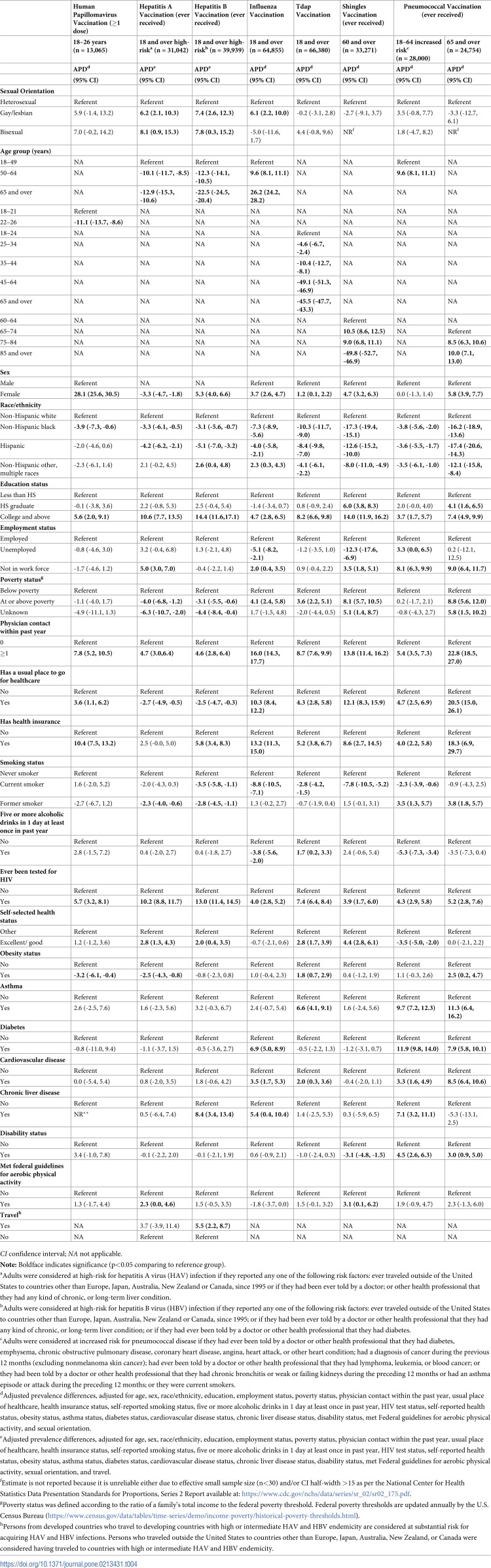
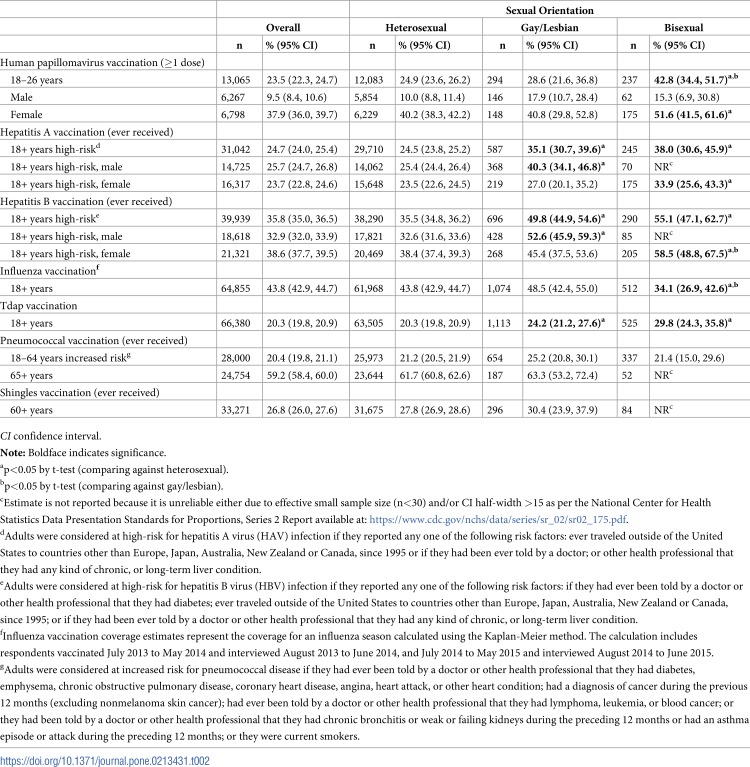
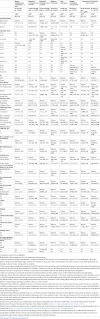
Significant differences were observed by sexual orientation for self-reported receipt of human papillomavirus (HPV), hepatitis A (HepA), hepatitis B (HepB), and influenza vaccination. Bisexual females (51.6%) had higher HPV coverage than heterosexual females (40.2%). Gay males (40.3% and 53.6%, respectively) had higher HepA and HepB coverage than heterosexual males (25.4% and 32.6%, respectively). Bisexual females (33.9% and 58.5%, respectively) had higher HepA and HepB coverage than heterosexual females (23.5% and 38.4%, respectively) and higher HepB coverage than lesbian females (45.4%). Bisexual adults (34.1%) had lower influenza coverage than gay/lesbian (48.5%) and heterosexual adults (43.8%). Except for the association of having self-identified as gay/lesbian orientation with greater likelihood of HepA, HepB, and influenza vaccination, sexual orientation was not associated with higher or lower likelihood of vaccination. Health status or other behavioral characteristics studied had no consistent relationship with vaccination among all populations.
Conclusion
Differences were identified in vaccination coverage among the U.S. adult population by self-reported sexual orientation. This study is the first to assess associations of sexual orientation with a comprehensive list of vaccinations. Findings from this study can serve as a baseline for monitoring changes over time. All populations could benefit from improved vaccination.
-
Subjects:
-
Source:PLoS One. 14(3)
-
Pubmed ID:30845220
-
Pubmed Central ID:PMC6405200
-
Document Type:
-
Name as Subject:
-
Place as Subject:
-
Volume:14
-
Issue:3
-
Collection(s):
-
Main Document Checksum:urn:sha256:8cdc8b2e65c3e9310265b3bd127f0d1e38750c5699666f515596e5a41fd1ca9e
-
Download URL:
-
File Type:
 [PDF
- 632.05 KB
]
[PDF
- 632.05 KB
]
Supporting Files


File Language:
English
ON THIS PAGE




CDC STACKS serves as an archival repository of CDC-published products including
scientific findings,
journal articles, guidelines, recommendations, or other public health information authored or
co-authored by CDC or funded partners.
As a repository, CDC STACKS retains documents in their original published format to ensure public access to scientific information.
As a repository, CDC STACKS retains documents in their original published format to ensure public access to scientific information.
You May Also Like
COLLECTION
CDC Public Access