


Neighborhood Environment and Urban Schoolchildren’s Risk for Being Overweight
Supporting Files

-
2013 Jul-Aug
-
File Language:
English
Details
-
Alternative Title:Am J Health Promot
-
Personal Author:
-
Description:Purpose.
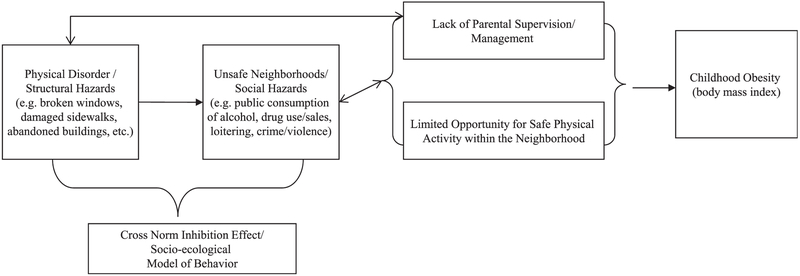
Child and adolescent obesity is increasingly prevalent and predisposes risk for poor physical and psychosocial health. Physical and social factors in the environment, such as neighborhood disorder, may be associated with childhood obesity. This study examines the association between living in a disordered neighborhood and being overweight among a sample of urban schoolchildren.
Design.
Baseline interview data, including height, weight, and hip circumference, were obtained from 313 elementary school-aged participants in a community-based epidemiologic study.
Setting.
The setting was Baltimore, Maryland, a large metropolitan city.
Subjects.
Subjects were elementary school students ages 8 to 12 years.
Measures.
To assess neighborhood characteristics, independent evaluators conducted objective environmental assessments using the Neighborhood Inventory for Environmental Typology instrument on the block faces (defined as one side of a city block between two intersections) where the children resided.
Analysis.
Logistic regression models with generalized estimating equations were used to examine the association between neighborhood disorder and children being overweight.
Results.
Neighborhood disorder showed a trend toward a statistically significant association with being overweight during childhood (odds ratio [OR], 1.03; confidence interval [CI], .99–1.07; p = .07) in the unadjusted model. Gender was significantly associated with being overweight, with female gender increasing the odds of being overweight by 50% in the sample (OR, 1.50; CI, 1.18–1.92; p < .01). After controlling for race, age, and comparative time spent on a sport, multivariable analyses revealed that gender (adjusted odds ratio [AOR], 2.42; CI, 1.63–3.59; p < .01) and neighborhood disorder (AOR, 1.09; CI, 1.03–1.15; p < . 01) were associated with being overweight. Further, an examination of interactions revealed girls (AOR, 2.40; CI, 1.65–3.49; p < .01) were more likely to be overweight compared with boys (AOR, 2.20; CI, 1.57–3.11; p < .01) living in neighborhoods with the same level of neighborhood disorder.
Conclusion.
Results suggest neighborhood hazards warrant additional consideration for their potential as obesogenic elements affecting gender-based disparities in weight among urban schoolchildren. Future studies in this area should include longitudinal examinations. (Am J Health Promot 2013;27[6]:410–416.)
-
Subjects:
-
Source:Am J Health Promot. 27(6):410-416
-
Pubmed ID:23458376
-
Pubmed Central ID:PMC6413872
-
Document Type:
-
Funding:
-
Volume:27
-
Issue:6
-
Collection(s):
-
Main Document Checksum:urn:sha256:33466fc406b6d5aa220ca2845274e6c70b012f80447af8c19320f7e641ebf5a0
-
Download URL:
-
File Type:
 [PDF
- 468.94 KB
]
[PDF
- 468.94 KB
]
Supporting Files


File Language:
English
ON THIS PAGE


CDC STACKS serves as an archival repository of CDC-published products including
scientific findings,
journal articles, guidelines, recommendations, or other public health information authored or
co-authored by CDC or funded partners.
As a repository, CDC STACKS retains documents in their original published format to ensure public access to scientific information.
As a repository, CDC STACKS retains documents in their original published format to ensure public access to scientific information.
You May Also Like
COLLECTION
CDC Public Access