



Rabies in a Dog Imported from Egypt — Connecticut, 2017
Supporting Files
Public Domain

-
Dec 21 2018
Details
-
Journal Article:Morbidity and Mortality Weekly Report (MMWR)
-
Personal Author:Hercules, Yonette ; Bryant, Nelva J. ; Wallace, Ryan M. ; Nelson, Randall ; Palumbo, Gabriel ; Williams, Jemeila N. ; Ocana, J. Miguel ; Shapiro, Sheryl ; Leavitt, Hilaire ; Slavinsk, Sally ; Newman, Alexandra ; Crum, David A. ; Joseph, Brian E. ; Orciari, Lillian A. ; Li, Yu ; Yager, Pamela ; Condori, Rene E. ; Stauffer, Kendra E. ; Brown, Clive
-
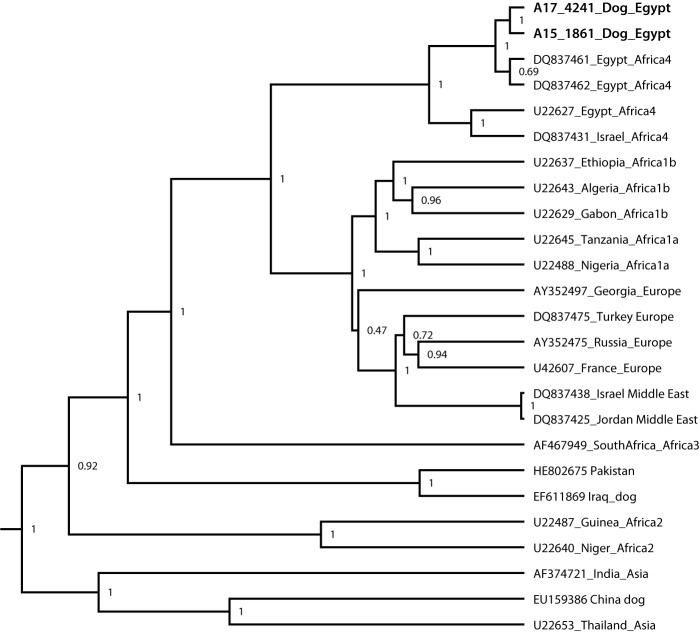
Description:In 2007, the United States successfully eliminated canine rabies Virus Variants. Globally, however, dogs remain the principal source of human rabies infections. Since 2007, three cases of canine rabies Virus Variants were reported in dogs imported into the United States, one each from India (2007), Iraq (2008), and Egypt (2015) (1-3). On December 20, 2017, a dog imported into the United States from Egypt was identified with rabies, representing the second case from Egypt in 3 years. An Egyptian-based animal rescue organization delivered four dogs from Cairo, Egypt, to a flight parent (a person solicited through social media, often not affiliated with the rescue organization, and usually compensated with an airline ticket), who transported the dogs to the United States The flight parent arrived at John F. Kennedy International Airport (JFK) in New York City and, via transporters (persons who shuttle dogs from one state to another), transferred the dogs to foster families; the dogs ultimately were adopted in three states. The Connecticut Department of Public Health Laboratory (CDPHL) confirmed the presence of a canine rabies Virus Variants in one of the dogs, a male aged 6 months that was adopted by a Connecticut family. An investigation revealed the possibility of falsified rabies vaccination documentation presented on entry at JFK, allowing the unvaccinated dog entry to the United States This report highlights the continuing risk posed by the importation of dogs inadequately vaccinated against rabies from high-risk countries and the difficulties in verifying any imported dog's health status and rabies vaccination History.
-
Subjects:
-
Source:MMWR Morbidity Mortal Weekly Rep. 67(50):1388-1391
-
Series:
-
DOI:
-
ISSN:0149-2195 (print) ; 1545-861X (digital)
-
Pubmed ID:30571670
-
Pubmed Central ID:PMC6342549
-
Document Type:
-
Place as Subject:
-
Pages in Document:4 pdf pages
-
Volume:67
-
Issue:50
-
Download URL:
-
File Type:
 [PDF - 103.65 KB]
 -
Collection(s):
-
Main Document Checksum:urn:sha-512:a673f11286c5dddb3bfef3b80f3498acca7d4198c9d2c23afa9060ae94bd652bfa2290f0cb20d034c93ba1ba164218f0436859aa837decd8e84c658d90781292
Supporting Files


 Was this page helpful?
 Found an issue?


CDC STACKS serves as an archival repository of CDC-published products including
scientific findings, journal articles, guidelines, recommendations, or other public health information authored or
co-authored by CDC or funded partners.
As a repository, CDC STACKS retains documents in their original published format to ensure public access to scientific information.
As a repository, CDC STACKS retains documents in their original published format to ensure public access to scientific information.
You May Also Like
COLLECTION
Morbidity and Mortality Weekly Report (MMWR)