



Preventing Intimate Partner Violence through Paid Parental Leave Policies
Supporting Files

-
May 30 2018
-
Available in CDC Stacks on September 01, 2019, 12:00 AM
File Language:
English
Details
-
Journal Article:Prev Med
-
Personal Author:
-
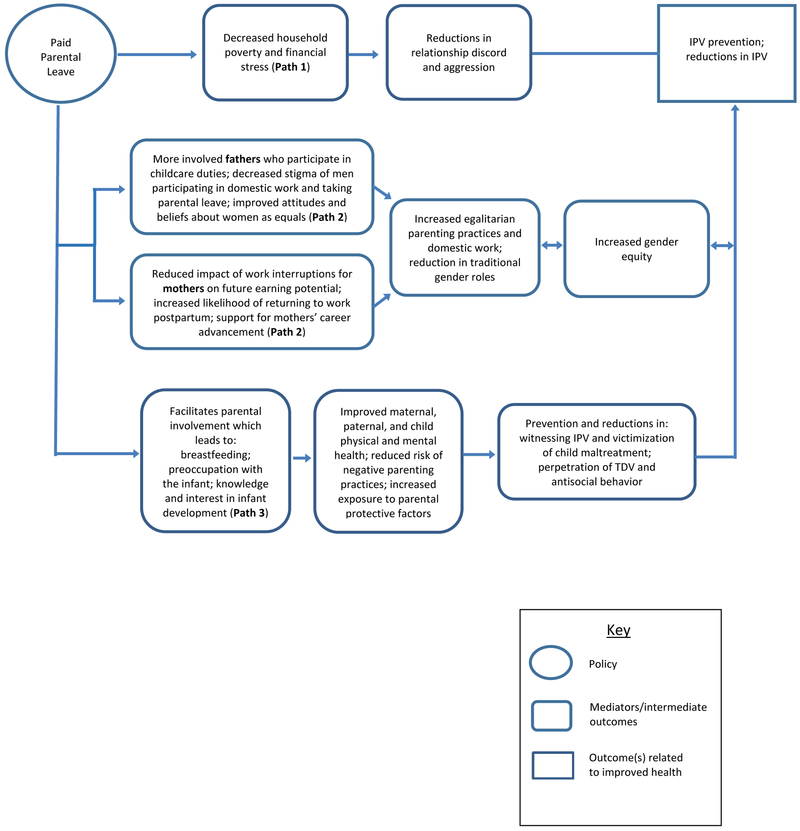
Description:Paid parental leave policies have the potential to strengthen economic supports, reduce family discord, and provide opportunities to empower women (Basile et al., 2016; Niolon et al., 2017). In this article, we present a theory of change and evidence to suggest how paid parental leave may impact intimate partner violence (IPV). In doing so, we present three mechanisms of change (i.e., reduction in financial stress, increase in egalitarian parenting practices, and promotion of child/parent bonding) through which paid parental leave could reduce rates of IPV. We also describe limitations of the current state of knowledge in this area, as well as opportunities for future research. Ultimately, our goal is to facilitate the identification and implementation of approaches that have the potential to reduce violence at the population level. Paid parental leave embodies the potential of policies to change societal-level factors and serve as an important prevention strategy for IPV.
-
Subjects:
-
Source:Prev Med. 114:18-23
-
DOI:
-
Pubmed ID:29857023
-
Pubmed Central ID:PMC6369689
-
Document Type:
-
Funding:
-
Genre:
-
Volume:114
-
Download URL:
-
File Type:
 [PDF - 453.29 KB]
 -
Collection(s):
-
Main Document Checksum:urn:sha-512:0e8e019677906cc9e6fec80538c4f5f8fe310bfbb0c3d06a72161ff35c3fd7698baa53c73c97450d22a448e9841ed13834a78bf738f8e555d8b35393b536f248
Supporting Files


File Language:
English
 Was this page helpful?
 Found an issue?

CDC STACKS serves as an archival repository of CDC-published products including
scientific findings, journal articles, guidelines, recommendations, or other public health information authored or
co-authored by CDC or funded partners.
As a repository, CDC STACKS retains documents in their original published format to ensure public access to scientific information.
As a repository, CDC STACKS retains documents in their original published format to ensure public access to scientific information.
You May Also Like
COLLECTION
CDC Public Access