


Prevalence of Obesity and Trends in Body Mass Index Among US Children and Adolescents, 1999-2010
Supporting Files

-
January 17 2012
-
File Language:
English
Details
-
Alternative Title:JAMA
-
Personal Author:
-
Description:Context
The prevalence of childhood obesity increased in the 1980s and 1990s but there were no significant changes in prevalence between 1999–2000 and 2007–2008 in the United States.
Objectives
To present the most recent estimates of obesity prevalence in US children and adolescents for 2009–2010 and to investigate trends in obesity prevalence and body mass index (BMI) among children and adolescents between 1999–2000 and 2009–2010.
Design, Setting, and Participant
Cross-sectional analyses of a representative sample (N=4111) of the US child and adolescent population (birth through 19 years of age) with measured heights and weights from the National Health and Nutrition Examination Survey 2009–2010.
Main Outcome Measures
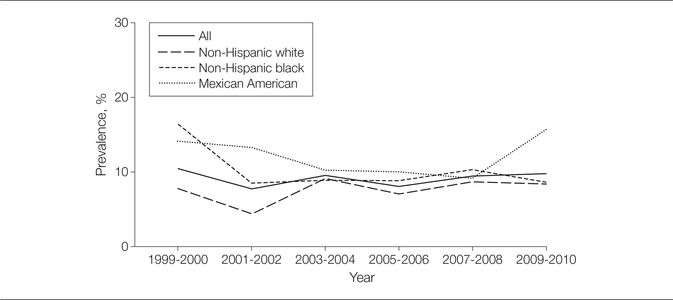
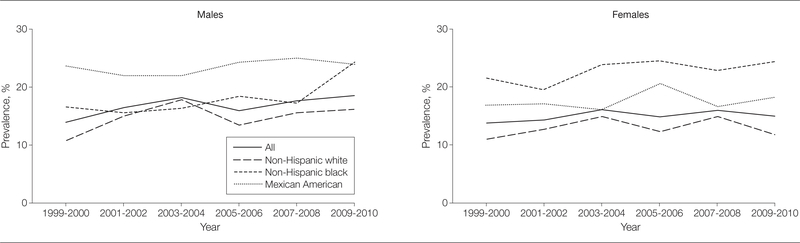
Prevalence of high weight-for-recumbent length (≥95th percentile on the growth charts) among infants and toddlers from birth to 2 years of age and obesity (BMI ≥95th percentile of the BMI-for-age growth charts) among children and adolescents aged 2 through 19 years. Analyses of trends in obesity by sex and race/ethnicity, and analyses of trends in BMI within sex-specific age groups for 6 survey periods (1999–2000, 2001–2002, 2003–2004, 2005–2006, 2007–2008, and 2009–2010) over 12 years.
Results
In 2009–2010, 9.7% (95% CI, 7.6%−12.3%) of infants and toddlers had a high weight-for-recumbent length and 16.9% (95% CI, 15.4%−18.4%) of children and adolescents from 2 through 19 years of age were obese. There was no difference in obesity prevalence among males (P=.62) or females (P=.65) between 2007–2008 and 2009–2010. However, trend analyses over a 12-year period indicated a significant increase in obesity prevalence between 1999–2000 and 2009–2010 in males aged 2 through 19 years (odds ratio, 1.05; 95% CI, 1.01–1.10) but not in females (odds ratio, 1.02; 95% CI, 0.98–1.07) per 2-year survey cycle. There was a significant increase in BMI among adolescent males aged 12 through 19 years (P=.04) but not among any other age group or among females.
Conclusion
In 2009–2010, the prevalence of obesity in children and adolescents was 16.9%; this was not changed compared with 2007–2008.
-
Subjects:
-
Source:JAMA. 307(5):483-490
-
Pubmed ID:22253364
-
Pubmed Central ID:PMC6362452
-
Document Type:
-
Funding:
-
Place as Subject:
-
Volume:307
-
Issue:5
-
Collection(s):
-
Main Document Checksum:urn:sha-512:9ceaec1df0c47cd101953888d231e57b130b490e9c94dcb9fb783f015348e5e6209ef49e90022dee8d7e96cfc836d06f6421cfe10adeeb453f184056c2287a68
-
Download URL:
-
File Type:
 [PDF
- 530.10 KB
]
[PDF
- 530.10 KB
]
Supporting Files


File Language:
English
ON THIS PAGE



CDC STACKS serves as an archival repository of CDC-published products including
scientific findings,
journal articles, guidelines, recommendations, or other public health information authored or
co-authored by CDC or funded partners.
As a repository, CDC STACKS retains documents in their original published format to ensure public access to scientific information.
As a repository, CDC STACKS retains documents in their original published format to ensure public access to scientific information.
You May Also Like
COLLECTION
CDC Public Access