


Association of Germline Genetic Test Type and Results With Patient Cancer Worry After Diagnosis of Breast Cancer
Supporting Files

-
12 19 2018
-
File Language:
English
Details
-
Alternative Title:JCO Precis Oncol
-
Personal Author:
-
Description:Background
There are concerns that multigene panel testing compared with BRCA1/ 2-only testing after diagnosis of breast cancer may lead to unnecessary patient worry about cancer because of more ambiguous results.
Methods
Patients with breast cancer diagnosed from 2013 to 2015 and accrued from SEER registries in Georgia and Los Angeles were surveyed (n = 5,080; response rate, 70%), and responses were merged with SEER data and germline genetic testing and results. We examined patient reports of cancer worry by test type and results in 1,063 women who linked to a genetic test and reported undergoing testing.
Results
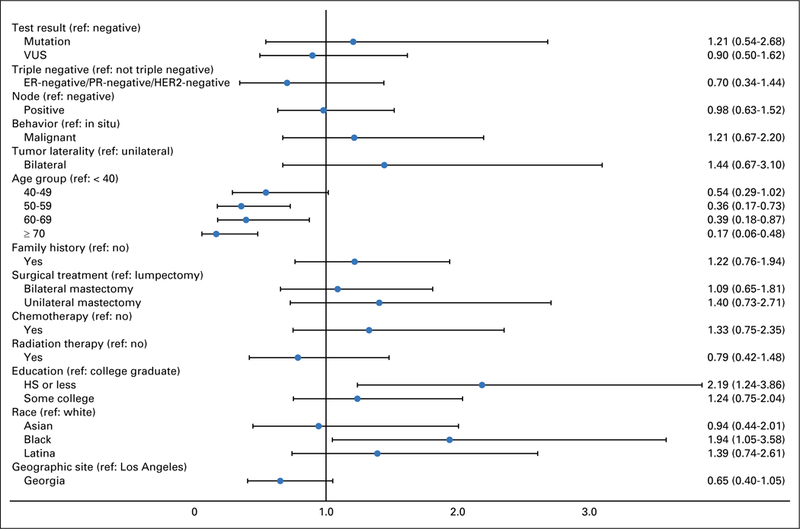
More than half of the sample (n = 640; 60.2%) received BRCA1/2-only testing versus 423 patients (39.8%) who had a multigene panel. A minority of tested patients reported substantial cancer worry after treatment: 11.1% (n = 130) reported higher impact of cancer worry, and 15.1% (n = 162) reported a high frequency of cancer worry (worrying often or almost always) in the past month. Impact of cancer worry did not substantively differ by test type, test result outcomes, or clinical or treatment factors. The odds ratio for higher impact of cancer worry was 0.81 (95% CI, 0.51 to 1.28) for multigene versus BRCA1/2-only testing. In a separate model, the odds ratios were 1.21 (95% CI, 0.54 to 2.68) and 0.90 (95% CI, 0.50 to 1.62) for pathogenic variant and variant of uncertain significance, respectively, versus a negative test (the reference group).
Conclusion
Compared with BRCA1/2 testing alone, multigene panel testing was not associated with increased cancer worry after diagnosis of breast cancer.
-
Source:JCO Precis Oncol. 2018 ; JCO Precis Oncol. 2018
-
Pubmed ID:30656245
-
Pubmed Central ID:PMC6333469
-
Document Type:
-
Funding:HHSN261201000140C/CA/NCI NIH HHSUnited States/ ; P30 CA046592/CA/NCI NIH HHSUnited States/ ; HHSN261201000035I/CA/NCI NIH HHSUnited States/ ; HHSN261201300015C/CA/NCI NIH HHSUnited States/ ; U58 DP003862/DP/NCCDPHP CDC HHSUnited States/ ; P01 CA163233/CA/NCI NIH HHSUnited States/ ; U58 DP003875/DP/NCCDPHP CDC HHSUnited States/ ; HHSN261201000035C/PC/NCI NIH HHSUnited States/ ; HHSN261201000034C/CA/NCI NIH HHSUnited States/
-
Volume:2018
-
Collection(s):
-
Main Document Checksum:urn:sha256:615cac81ac302f5d640064d0a2421f680a93cc2fb571da0579cd522faf803ca4
-
Download URL:
-
File Type:
 [PDF
- 500.25 KB
]
[PDF
- 500.25 KB
]
Supporting Files


File Language:
English
ON THIS PAGE


CDC STACKS serves as an archival repository of CDC-published products including
scientific findings,
journal articles, guidelines, recommendations, or other public health information authored or
co-authored by CDC or funded partners.
As a repository, CDC STACKS retains documents in their original published format to ensure public access to scientific information.
As a repository, CDC STACKS retains documents in their original published format to ensure public access to scientific information.