



Uptake and safety of Hepatitis B vaccination during pregnancy: A Vaccine Safety Datalink study☆
Supporting Files

-
2018/10/01
-
Available in CDC Stacks on 2019-10-01T00:00:00Z
File Language:
English
Details
-
Journal Article:Vaccine
-
Personal Author:Groom, Holly C. ; Irving, Stephanie A. ; Koppolu, Padma ; Smith, Ning ; Vazquez-Benitez, Gabriela ; Kharbanda, Elyse O. ; Daley, Matthew F. ; Donahue, James G. ; Getahun, Darios ; Jackson, Lisa A. ; Kawai, Alison Tse ; Klein, Nicola P. ; McCarthy, Natalie L. ; Nordin, James D. ; Sukumaran, Lakshmi ; Naleway, Allison L.
-
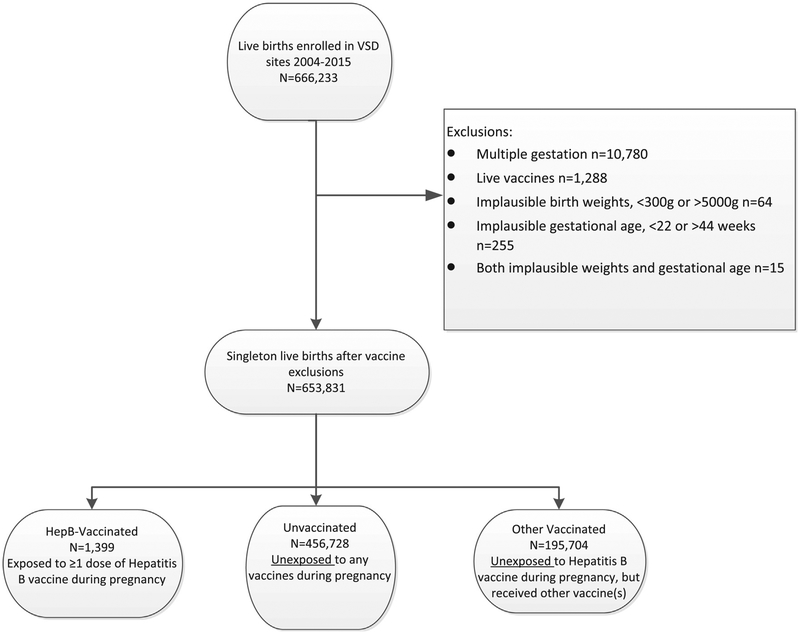
Description:Introduction: ; Hepatitis B virus (HBV) infection acquired during pregnancy can pose a risk to the infant at birth that can lead to significant and lifelong morbidity. Hepatitis B vaccine (HepB) is recommended for anyone at increased risk for contracting HBV infection, including pregnant women. Limited data are available on the safety of HepB administration during pregnancy. ; Objectives: ; To assess the frequency of maternal HepB receipt among pregnant women and evaluate the potential association between maternal vaccination and pre-specified maternal and infant safety outcomes. ; Methods: ; We examined a retrospective cohort of pregnancies in the Vaccine Safety Datalink (VSD) resulting in live birth outcomes from 2004 through 2015. Eligible pregnancies in women aged 12-55 years who were continuously enrolled from 6 months pre-pregnancy to 6 weeks postpartum in VSD integrated health systems were included. We compared pregnancies with HepB exposure to those with other vaccine exposures, and to those with no vaccine exposures. High-risk conditions for contracting HBV infection were identified up to one-year prior to or during the pregnancy using ICD-9 codes. Maternal and fetal adverse events were also evaluated according to maternal HepB exposure status. ; Results: ; Among over 650,000 pregnancies in the study period, HepB was administered at a rate of 2.1 per 1000 pregnancies (n= 1399), commonly within the first 5 weeks of pregnancy. Less than 3% of the HepB-exposed group had a high-risk ICD-9 code indicating need for HepB; this was similar to the rate among HepB unvaccinated groups. There were no significant associations between HepB exposure during pregnancy and gestational hypertension, gestational diabetes, pre-eclampsia/eclampsia, cesarean delivery, pre-term delivery, low birthweight or small for gestational age infants. ; Conclusions: ; Most women who received maternal HepB did not have high-risk indications for vaccination. No increased risk for the adverse events that were examined were observed among women who received maternal HepB or their offspring.
-
Subjects:
-
Keywords:
-
Source:Vaccine. 36(41):6111-6116
-
DOI:
-
Pubmed ID:30194002
-
Pubmed Central ID:PMC6325631
-
Document Type:
-
Funding:
-
Genre:
-
Volume:36
-
Issue:41
-
Download URL:
-
File Type:
 [PDF - 471.29 KB]
 -
Collection(s):
-
Main Document Checksum:urn:sha-512:6c0a6ab5461987f5c237222d392a0f89e2b8a1496a3823fa18daa3bf80ac8694c81f2b0d880f9f1dc4c74d083415f76e0d1b37c178a5095b4f73aa5e2e5bc3cf
Supporting Files


File Language:
English
 Was this page helpful?
 Found an issue?

CDC STACKS serves as an archival repository of CDC-published products including
scientific findings, journal articles, guidelines, recommendations, or other public health information authored or
co-authored by CDC or funded partners.
As a repository, CDC STACKS retains documents in their original published format to ensure public access to scientific information.
As a repository, CDC STACKS retains documents in their original published format to ensure public access to scientific information.
You May Also Like
COLLECTION
CDC Public Access