



Salmonella enterica Serotype Javiana Infections Linked to a Seafood Restaurant in Maricopa County, Arizona, 2016
Supporting Files

-
August 2018
-
Available in CDC Stacks on August 01, 2019, 12:00 AM
File Language:
English
Details
-
Alternative Title:J Food Prot
-
Personal Author:
-
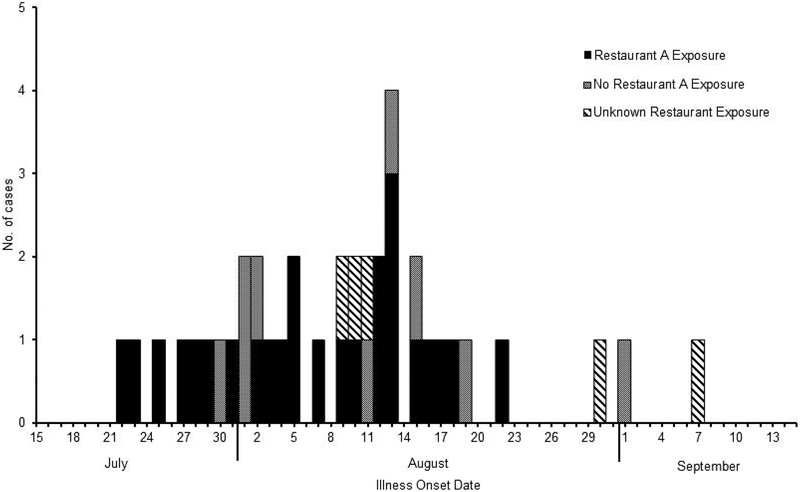
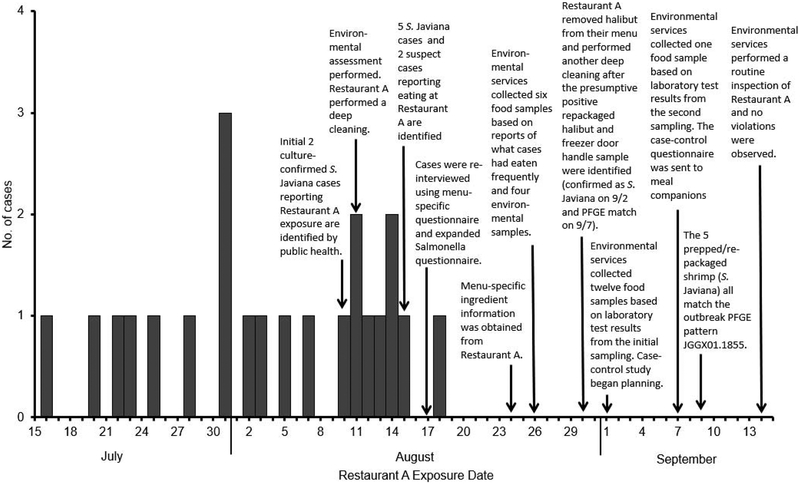
Description:On 10 August 2016, the Maricopa County Department of Public Health identified culture-confirmed Salmonella enterica serotype Javiana isolates from two persons who reported eating at a seafood restaurant; seven additional cases were reported by 15 August. We investigated to identify a source and prevent further illness. We interviewed persons with laboratory-reported Salmonella Javiana infection. Pulsed-field gel electrophoresis (PFGE) and whole genome sequencing of isolates were performed. A case was defined as diarrheal illness in a person during July to September 2016; confirmed cases had Salmonella Javiana isolate yielding outbreak-related PFGE patterns; probable cases had diarrheal illness and an epidemiologic link to a confirmed case. Case finding was performed (passive surveillance and identification of ill meal companions). A case-control study assessed risk factors for Salmonella Javiana infection among restaurant diners; control subjects were chosen among meal companions. No restaurant workers reported illness. Foods were reportedly cooked according to the Food Code. Food and environmental samples were collected and cultured; Salmonella Javiana with an indistinguishable PFGE pattern was isolated from portioned repackaged raw shrimp, halibut, and a freezer door handle. We identified 50 Salmonella Javiana cases (40 confirmed and 10 probable); illness onset range was from 22 July to 17 September 2016. Isolates from 40 patients had highly related PFGE patterns. Thirty-three (73%) of 45 patients interviewed reported eating at the restaurant. Among 21 case patients and 31 control subjects, unfried cooked shrimp was associated with illness (odds ratio, 6.7; 95% confidence interval, 1.8 to 24.9; P = 0.004). Among restaurant diners, laboratory and case-control evidence indicated shrimp as the possible outbreak source; poor thermal inactivation of Salmonella on shrimp is theorized as a possible cause. Cross-contamination might have prolonged this outbreak; however, the source was not identified and highlights limitations that can arise during these types of investigations.
-
Subjects:
-
Source:J Food Prot. 81(8):1283-1292
-
Pubmed ID:29985066
-
Pubmed Central ID:PMC6309180
-
Document Type:
-
Funding:
-
Place as Subject:
-
Volume:81
-
Issue:8
-
Download URL:
-
File Type:
 [PDF - 444.01 KB]
 -
Collection(s):
-
Main Document Checksum:urn:sha256:170d199a816c3307ec49adaab8bbcdc8353e22a70c4b3a5f96aca93bc009471b
Supporting Files


File Language:
English
 Was this page helpful?
 Found an issue?

CDC STACKS serves as an archival repository of CDC-published products including
scientific findings, journal articles, guidelines, recommendations, or other public health information authored or
co-authored by CDC or funded partners.
As a repository, CDC STACKS retains documents in their original published format to ensure public access to scientific information.
As a repository, CDC STACKS retains documents in their original published format to ensure public access to scientific information.
You May Also Like
COLLECTION
CDC Public Access