



Mobile Mammography Participation Among Medically Underserved Women: A Systematic Review
Supporting Files
Public Domain

-
Nov 15 2018
File Language:
English
Details
-
Journal Article:Preventing Chronic Disease (PCD)
-
Personal Author:
-
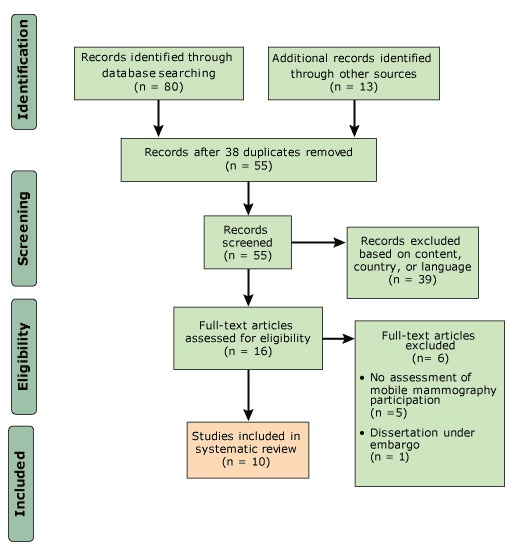
Description:Introduction ; Although breast cancer deaths have declined, the mortality rate among women from medically underserved communities is disproportionally high. Screening mammography is the most effective tool for detecting breast cancer in its early stages, yet many women from medically underserved communities do not have adequate access to screening mammograms. Mobile mammography may be able to bridge this gap by providing screening mammograms at no cost or low cost and delivering services to women in their own neighborhoods, thus eliminating cost and transportation barriers. The objective of this systematic review was to describe the scope and impact of mobile mammography programs in promoting mammographic screening participation among medically underserved women. ; Methods ; We searched electronic databases for English-language articles published in the United States from January 2010 through March 2018 by using the terms “mobile health unit,” “mammogram,” “mammography,” and “breast cancer screening.” Of the 93 articles initially identified, we screened 55; 16 were eligible to be assessed and 10 qualified for full text review and data extraction. Each study was coded for study purpose, research design, data collection, population targeted, location, sample size, outcomes, predictors, analytical methods, and findings. ; Results ; Of the 10 studies that qualified for review, 4 compared mobile mammography users with users of fixed units, and the other 6 characterized mobile mammography users only. All the mobile mammography units included reached underserved women. Most of the women screened in mobile units were African American or Latina, low income, and/or uninsured. Mobile mammography users reported low adherence to 1-year (12%–34%) and 2-year (40%–48%) screening guidelines. Some difficulties faced by mobile clinics were patient retention, patient follow-up of abnormal or inconclusive findings, and women inaccurately perceiving their breast cancer risk. ; Conclusion ; Mobile mammography clinics may be effective at reaching medically underserved women. Adding patient navigation to mobile mammography programs may promote attendance at mobile sites and increase follow-up adherence. Efforts to promote mammographic screening should target women from racial/ethnic minority groups, women from low-income households, and uninsured women. Future research is needed to understand how to best improve visits to mobile mammography clinics.
-
Subjects:
-
Source:Prev Chronic Dis. 15
-
DOI:
-
ISSN:1545-1151
-
Pubmed ID:30447104
-
Pubmed Central ID:PMC6266518
-
Document Type:
-
Place as Subject:
-
Location:
-
Volume:15
-
Download URL:
-
File Type:
 [PDF - 389.19 KB]
 -
Collection(s):
-
Main Document Checksum:urn:sha-512:7eeb57e516ec76e66f71442cad0708d1be4236c48ab5fc2604e5414173db949d373a06588083cef2bc168eb952119655d44273959e11a6f75eeb8218e9dfa5ef
Supporting Files


File Language:
English
 Was this page helpful?
 Found an issue?

CDC STACKS serves as an archival repository of CDC-published products including
scientific findings, journal articles, guidelines, recommendations, or other public health information authored or
co-authored by CDC or funded partners.
As a repository, CDC STACKS retains documents in their original published format to ensure public access to scientific information.
As a repository, CDC STACKS retains documents in their original published format to ensure public access to scientific information.
You May Also Like
COLLECTION
Preventing Chronic Disease