



Unresolved Splenomegaly in Recently Resettled Congolese Refugees ― Multiple States, 2015–2018
Supporting Files
Public Domain

-
Dec 14 2018
Details
-
Journal Article:Morbidity and Mortality Weekly Report (MMWR)
-
Personal Author:Zambrano, Laura D. ; Samson, Olivia ; Phares, Christina ; Jentes, Emily ; Weinberg, Michelle ; Goers, Matthew ; Kachur, S. Patrick ; McDonald, Robert ; Morawski, Bozena ; Njuguna, Henry ; Bakhsh, Yasser ; Laws, Rebecca ; Peak, Corey ; Iverson, Sally Ann ; Bezold, Carla ; Allkhenfr, Hayder ; Horth, Roberta ; Yang, Jun ; Miller, Susan ; Kacka, Michael ; Davids, Abby ; Mortimer, Margaret ; Khan, Nomana ; Stauffer, William ; Marano, Nina
-
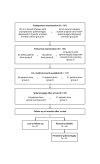
Description:In 2014, panel physicians from the International Organization for Migration (IOM), who conduct Department of State-required predeparture examinations for U.S.-bound refugees at resettlement sites in Uganda, noticed an unusually high number of Congolese refugees with enlarged spleens, or splenomegaly. Many conditions can cause splenomegaly, such as various infections, liver disease, and cancer. Splenomegaly can result in hematologic disturbances and abdominal pain and can increase the risk for splenic rupture from blunt trauma, resulting in life-threatening internal bleeding. On CDC's advice, panel physicians implemented an enhanced Surveillance and treatment protocol that included screening for malaria (through thick and thin smears and rapid diagnostic tTesting), schistosomiasis, and several other conditions; treatment of any condition identified as potentially associated with splenomegaly; and empiric treatment for the most likely etiologies, including malaria and schistosomiasis. CDC recommended further treatment for malaria with primaquine after arrival, after glucose-6-phosphate dehydrogenase tTesting, to target liver-stage parasites. Despite this recommended treatment protocol, 35 of 64 patients with available follow-up records had splenomegaly that persisted beyond 6 months after resettlement. Among 85 patients who were diagnosed with splenomegaly through abdominal palpation or ultrasound at any point after resettlement, 53 had some hematologic abnormality (leukopenia, anemia, or thrombocytopenia), 16 had evidence of current or recent malaria infection, and eight had evidence of schistosomiasis. Even though primaquine was provided to a minority of patients in this cohort, it should be provided to all eligible patients with persistent splenomegaly, and repeated antischistosomal therapy should be provided to patients with evidence of current or recent schistosomiasis. Given substantial evidence of familial clustering of cases, family members of patients with known splenomegaly should be proactively screened for this condition.
-
Subjects:
-
Source:MMWR Morbidity Mortal Weekly Rep. 67(49):1358-1362
-
Series:
-
ISSN:0149-2195 (print) ; 1545-861X (digital)
-
Pubmed ID:30543602
-
Pubmed Central ID:PMC6300079
-
Document Type:
-
Place as Subject:
-
Pages in Document:5 pdf pages
-
Volume:67
-
Issue:49
-
Download URL:
-
File Type:
 [PDF - 208.34 KB]
 -
Collection(s):
-
Main Document Checksum:urn:sha-512:aef06a43e16c50038adb2aab1f74b5285fea2a3ec432ca85647a2cdf92c64cff340b45d64bf768adaf1dabaa5a1fd27d794a5089f0abc711e3a56728536df556
Supporting Files


 Was this page helpful?
 Found an issue?


CDC STACKS serves as an archival repository of CDC-published products including
scientific findings, journal articles, guidelines, recommendations, or other public health information authored or
co-authored by CDC or funded partners.
As a repository, CDC STACKS retains documents in their original published format to ensure public access to scientific information.
As a repository, CDC STACKS retains documents in their original published format to ensure public access to scientific information.
You May Also Like
COLLECTION
Morbidity and Mortality Weekly Report (MMWR)