



Influenza A(H3N2) Variant Virus Outbreak at Three Fairs — Maryland, 2017
Supporting Files
Public Domain

-
Oct 26 2018
Details
-
Journal Article:Morbidity and Mortality Weekly Report (MMWR)
-
Personal Author:Duwell, Monique M. ; Blythe, David ; Radebaugh, Michael W. ; Kough, Erin M. ; Bachaus, Brian ; Crum, David A. ; Perkins, Keith A. ; Blanton, Lenee ; Davis, C. Todd ; Jang, Yunho ; Vincent, Amy ; Chang, Jennifer ; Abney, Dianna E. ; Gudmundson, Lisa ; Brewster, Meenakshi G. ; Polsky, Larry ; Rose, David C. ; Feldman, Katherine A.
-
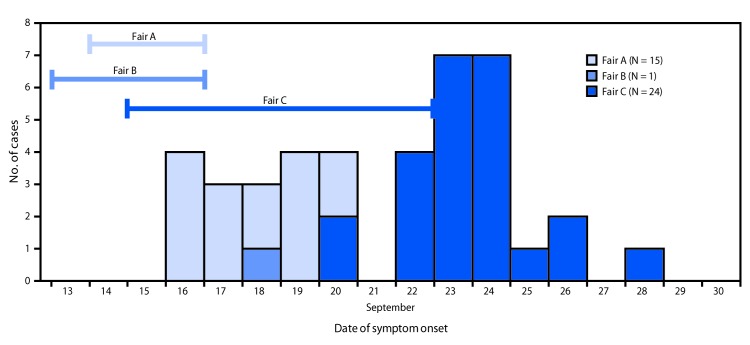
Description:On September 17, 2017, the Maryland Department of Agriculture (MDA) was notified by fair and 4-H officials of ill swine at agricultural fair A, held September 14-17. That day, investigation of the 107 swine at fair A revealed five swine with fever and signs of upper respiratory tract illness. All five respiratory specimens collected from these swine tested positive for influenza A Virus at the MDA Animal Health Laboratory, and influenza A(H3N2) Virus was confirmed in all specimens by the U.S. Department of Agriculture National Veterinary Services Laboratory (NVSL). On September 18, MDA was notified by fair and 4-H officials that swine exhibitors were also ill. MDA alerted the Maryland Department of Health (MDH). A joint investigation with MDH and the local health department was started and later broadened to Maryland agricultural fairs B (September 13-17) and C (September 15-23). In total, 76 persons underwent tTesting for Variants influenza, and influenza A(H3N2) Variants (A(H3N2)v) Virus infection was identified in 40 patients with exposure to swine at these fairs (Figure), including 30 (75%) who had more than one characteristic putting them at high risk for serious influenza Complications; 24 (60%) of these were children aged <5 years. Twenty-six (65%) patients reported direct contact with swine (i.e., touching swine or swine enclosure), but 14 (35%) reported only indirect contact (e.g., walking through a swine barn). Two children required hospitalization; all patients recovered. This outbreak highlights the risk, particularly among children, for contracting Variants influenza Virus at agricultural fairs after direct or indirect swine contact. Publicizing CDC's recommendation that persons at high risk for serious influenza Complications avoid pigs and swine barns might help prevent future Variants influenza outbreaks among vulnerable groups (1).
-
Subjects:
-
Source:MMWR Morbidity Mortal Weekly Rep. 67(42):1169-1173
-
Series:
-
DOI:
-
ISSN:0149-2195 (print) ; 1545-861X (digital)
-
Pubmed ID:30359341
-
Pubmed Central ID:PMC6290816
-
Document Type:
-
Place as Subject:
-
Pages in Document:5 pdf pages
-
Volume:67
-
Issue:42
-
Download URL:
-
File Type:
 [PDF - 159.62 KB]
 -
Collection(s):
-
Main Document Checksum:urn:sha-512:45c108441aa7e7c6f6503e78f6f0bd67234302e0c25fd92aacc991313b082a6f2a11deca11e27fcf8877f9e3a311b1d9366d046e754be6dffdba17022790c475
Supporting Files


 Was this page helpful?
 Found an issue?

CDC STACKS serves as an archival repository of CDC-published products including
scientific findings, journal articles, guidelines, recommendations, or other public health information authored or
co-authored by CDC or funded partners.
As a repository, CDC STACKS retains documents in their original published format to ensure public access to scientific information.
As a repository, CDC STACKS retains documents in their original published format to ensure public access to scientific information.
You May Also Like
COLLECTION
Morbidity and Mortality Weekly Report (MMWR)