



Vulnerability to the Cardiovascular Effects of Ambient Heat in Six U.S. Cities: Results from the Multi-Ethnic Study of Atherosclerosis (MESA)
Supporting Files

-
11 2018
-
Available in CDC Stacks on 2019-11-01T00:00:00Z
File Language:
English
Details
-
Journal Article:Epidemiology
-
Personal Author:
-
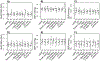
Description:Background: ; With climate change, temperatures are increasing. Heat-associated health events disproportionately affect certain subpopulations. However, prior research has often lacked information on individual-level health and air conditioning and neighborhood stressors/protections. ; Objectives: ; To assess whether 1) heat (2-day mean temperature above local 75th percentiles) is associated with increased heart rate and decreased blood pressure, controlling for age, time, season, daily ozone, and daily particulate matter (PM2.5), and 2) associations differ by anti-hypertensive-medication use, renal function, fasting glucose, emotional support, air conditioning ownership and use, normalized difference vegetation index, neighborhood safety, and residence-specific oxides of nitrogen and PM2.5. ; Methods: ; Health and behavioral characteristics were obtained repeatedly on participants of the Multi-Ethnic Study of Atherosclerosis in six U.S. sites (2000–2010). These were linked with airport temperature, air quality, and satellite- and survey-derived neighborhood characteristics. We used a fixed-effects design, regressing health outcomes on linear temperature splines with knots at the 75th percentiles, interaction terms for each characteristic, and adjustment for month-of-year, age, PM2.5, and ozone. ; Results: ; Overall, heat was not associated with heart rate. However, for a 2 degree-Celsius increase in heat, systolic blood pressure (SBP) decreased by 1.1 mmHg (95% CI: −1.6, −0.6) and diastolic by 0.3 mmHg (95% CI: −0.6, −0.1). Among non-users of anti-hypertensive medications, heat-associated decreases in SBP were 2.1 mmHg greater among individuals with central air conditioning vs. without. Confidence intervals around the remaining modifiers were wide after multiple-comparisons corrections or sensitivity analyses. ; Conclusions: ; Outdoor heat is associated with decreasing blood pressure, and cardiovascular vulnerability may vary primarily by ownership of central air conditioning.
-
Keywords:
-
Source:Epidemiology. 29(6):756-764
-
DOI:
-
Pubmed ID:30113342
-
Pubmed Central ID:PMC6233295
-
Document Type:
-
Funding:UL1 TR000433/TR/NCATS NIH HHSUnited States/ ; T42 OH008455/OH/NIOSH CDC HHSUnited States/ ; N01HC95160/HL/NHLBI NIH HHSUnited States/ ; N01HC95163/HL/NHLBI NIH HHSUnited States/ ; UL1 TR001079/TR/NCATS NIH HHSUnited States/ ; N01HC95169/HL/NHLBI NIH HHSUnited States/ ; N01HC95164/HL/NHLBI NIH HHSUnited States/ ; N01HC95162/HL/NHLBI NIH HHSUnited States/ ; N01HC95165/HL/NHLBI NIH HHSUnited States/ ; N01HC95159/HL/NHLBI NIH HHSUnited States/ ; P30 ES017885/ES/NIEHS NIH HHSUnited States/ ; HHSN268201500003I/HL/NHLBI NIH HHSUnited States/ ; N01HC95167/HL/NHLBI NIH HHSUnited States/ ; UL1 TR002240/TR/NCATS NIH HHSUnited States/ ; UL1 TR000040/TR/NCATS NIH HHSUnited States/ ; N01HC95166/HL/NHLBI NIH HHSUnited States/ ; T42 OH008433/OH/NIOSH CDC HHSUnited States/ ; HHSN268201500003C/HL/NHLBI NIH HHSUnited States/ ; K99 ES026198/ES/NIEHS NIH HHSUnited States/ ; N01HC95168/HL/NHLBI NIH HHSUnited States/ ; R00 ES026198/ES/NIEHS NIH HHSUnited States/ ; N01HC95161/HL/NHLBI NIH HHSUnited States/ ; UL1 TR001420/TR/NCATS NIH HHSUnited States/
-
Genre:
-
Volume:29
-
Issue:6
-
Download URL:
-
File Type:
 [PDF - 440.58 KB]
 -
Collection(s):
-
Main Document Checksum:urn:sha-512:bdbd5dc5745e1008d161f39cfebec84193bf2f50b55d3042ab3fe4dc833dc4314c3234b9576a35d50b18e7a26d08c1f91b8ff94cc03c269ab5d7e7af14930276
Supporting Files


File Language:
English
 Was this page helpful?
 Found an issue?


CDC STACKS serves as an archival repository of CDC-published products including
scientific findings, journal articles, guidelines, recommendations, or other public health information authored or
co-authored by CDC or funded partners.
As a repository, CDC STACKS retains documents in their original published format to ensure public access to scientific information.
As a repository, CDC STACKS retains documents in their original published format to ensure public access to scientific information.
You May Also Like
COLLECTION
CDC Public Access