



Self-Efficacy and Adherence Behaviors in Rheumatoid Arthritis Patients
Supporting Files

-
Oct 18 2018
File Language:
English
Details
-
Journal Article:Preventing Chronic Disease (PCD)
-
Personal Author:
-
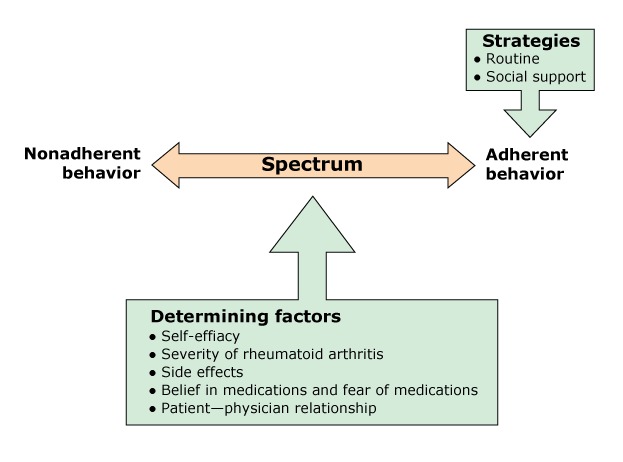
Description:Introduction ; Rheumatoid arthritis (RA) is a common disease that requires patient self-management with chronic medications. Adherence rates for RA medications are suboptimal. This study explores medication adherence and self-efficacy behaviors among RA patients. ; Methods ; We conducted a qualitative study comprising focus groups and individual interviews. Nineteen participants were recruited and screened to participate in three 90-minute focus groups (n = 13) and six 60-minute individual interviews. We created and maintained a codebook to analyze data. Interviews were analyzed by using NViVo qualitative analysis software. ; Results ; Key points in participant interviews were 1) self-efficacy as influenced by the ability to establish routines, and having an understanding relationship with their healthcare provider; 2) self-efficacy to adjust medications depended on having permission from providers to adjust medications, perceptions of the effectiveness of medications, and confidence in self-knowledge to make appropriate adjustments; and 3) changes in self-efficacy over time were influenced by initial denial and later acceptance of the diagnosis. Participant interviews revealed that medication adherence is a spectrum that ranges from adherent to nonadherent. ; Conclusion ; Participants’ experience with RA medications revealed varied underlying reasons for adherence behaviors. Recognizing adherence as a dynamic behavior has important implications for how adherence interventions are designed. For example, participants reported adjusting medications in response to the unpredictable nature of RA. Interventions could collect information about RA symptoms and be tailored to provide adherence support at times when patients need it most. The importance of self-efficacy in influencing participants’ adherence behaviors is an area for continuing research among patients and providers.
-
Subjects:
-
Source:Prev Chronic Dis. 15
-
DOI:
-
ISSN:1545-1151
-
Pubmed ID:30339772
-
Pubmed Central ID:PMC6198676
-
Document Type:
-
Funding:
-
Volume:15
-
Download URL:
-
File Type:
 [PDF - 292.47 KB]
 -
Collection(s):
-
Main Document Checksum:urn:sha-512:e95755a59c3cae851326c916f0c4c13788dcbf10e55530a0c3da1d59883b7461e345837fcacb1bbcf56bb2cf154e6d1a8bbdbe0464fcaf9c9ab5d798dcdecd39
Supporting Files


File Language:
English
 Was this page helpful?
 Found an issue?

CDC STACKS serves as an archival repository of CDC-published products including
scientific findings, journal articles, guidelines, recommendations, or other public health information authored or
co-authored by CDC or funded partners.
As a repository, CDC STACKS retains documents in their original published format to ensure public access to scientific information.
As a repository, CDC STACKS retains documents in their original published format to ensure public access to scientific information.
You May Also Like
COLLECTION
Preventing Chronic Disease