


Before the here and now: What we can learn from variation in spatiotemporal patterns of changing heart disease mortality by age group, time period, and birth cohort
Supporting Files

-
September 25 2018
-
File Language:
English
Details
-
Alternative Title:Soc Sci Med
-
Personal Author:
-
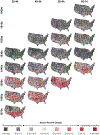
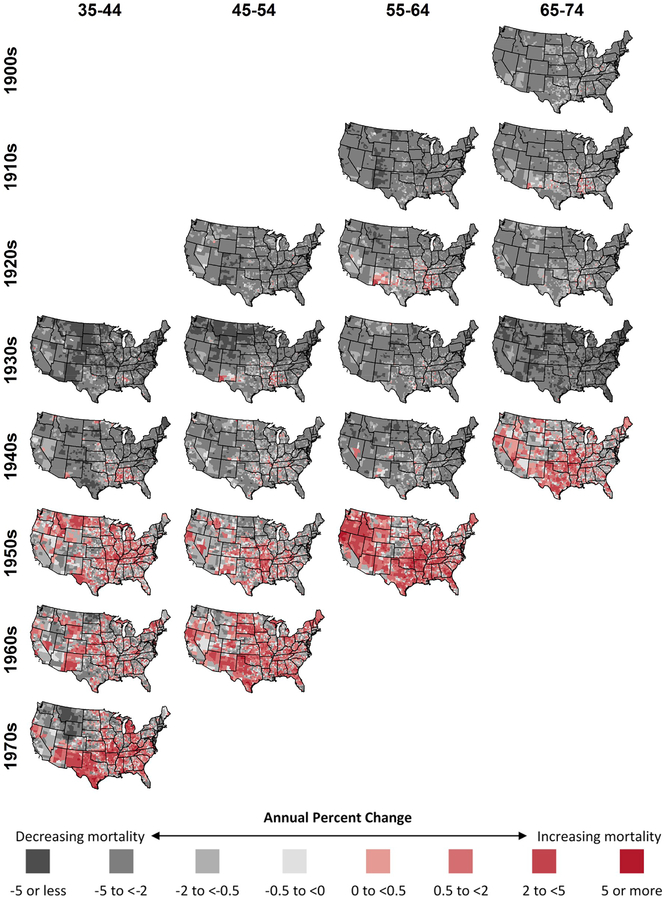
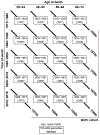
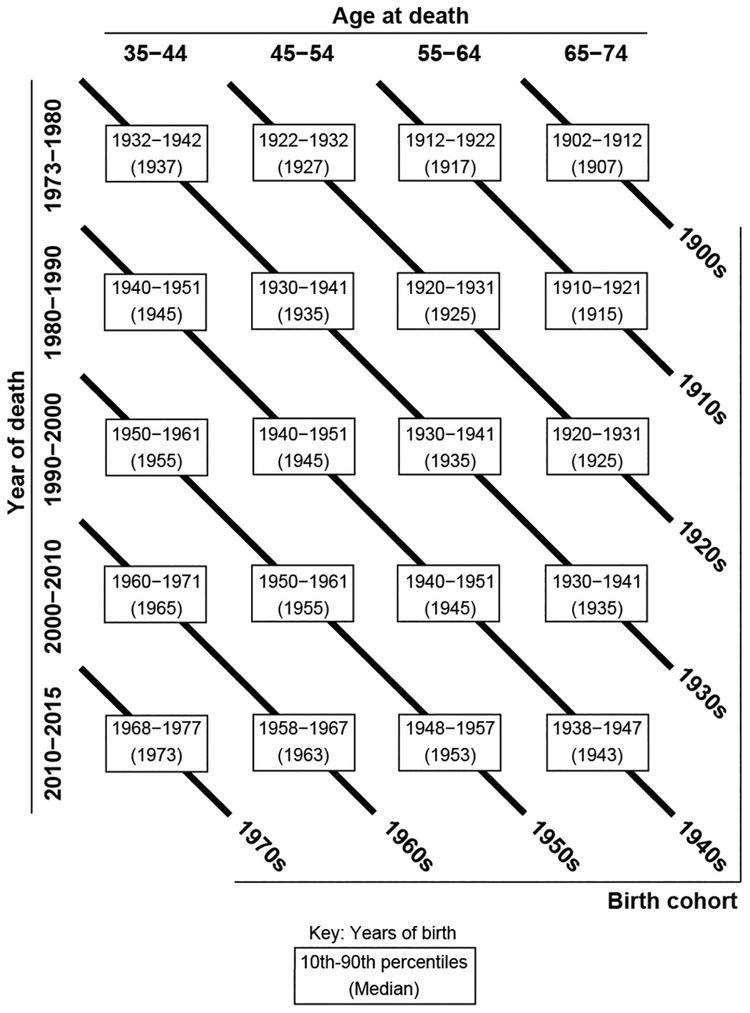
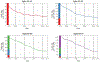
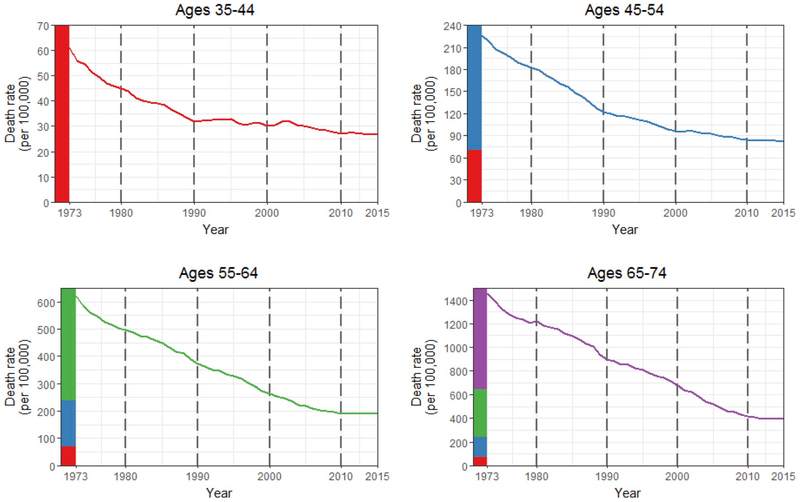
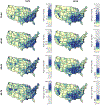
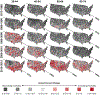
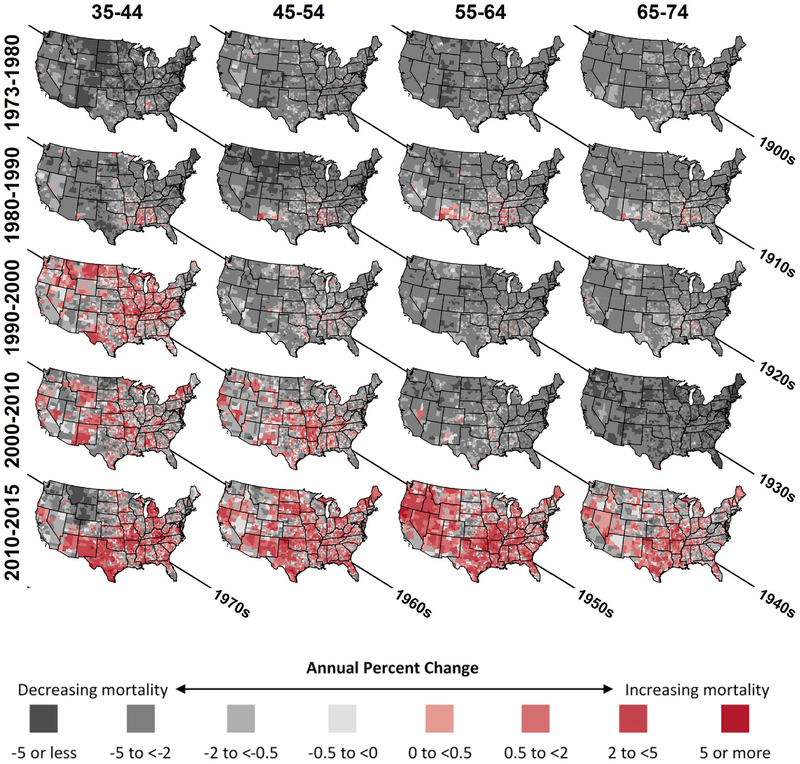
Description:One hypothesized explanation for the recent slowing of declines in heart disease death rates is the generational shift in the timing and accumulation of risk factors. However, directly testing this hypothesis requires historical age-group-specific risk factor data that do not exist. Using national death records, we compared spatiotemporal patterns of heart disease death rates by age group, time period, and birth cohort to provide insight into possible drivers of trends. To do this, we calculated county-level percent change for five time periods (1973-1980, 1980-1990, 1990-2000, 2000-2010, 2010-2015) for four age groups (35-44, 45-54, 55-64, 65-74), resulting in eight birth cohorts for each decade from the 1900s through the 1970s. From 1973 through 1990, few counties experienced increased heart disease death rates. In 1990-2000, 49.0% of counties for ages 35-44 were increasing, while all other age groups continued to decrease. In 2000-2010, heart disease death rates for ages 45-54 increased in 30.4% of counties. In 2010-2015, all four age groups showed widespread increasing county-level heart disease death rates. Likewise, birth cohorts from the 1900s through the 1930s experienced consistently decreasing heart disease death rates in almost all counties. Similarly, with the exception of 2010-2015, most counties experienced decreases for the 1940s birth cohort. For birth cohorts in the 1950s, 1960s, and 1970s, increases were common and geographically widespread for all age groups and calendar years. This analysis revealed variation in trends across age groups and across counties. However, trends in heart disease death rates tended to be generally decreasing and increasing for early and late birth cohorts, respectively. These findings are consistent with the hypothesis that recent increases in heart disease mortality stem from the beginnings of the obesity and diabetes epidemics. However, the common geographic patterns within the earliest and latest time periods support the importance of place-based macro-level factors.
-
Subjects:
-
Source:Soc Sci Med. 217:97-105
-
Pubmed ID:30300762
-
Pubmed Central ID:PMC6211179
-
Document Type:
-
Funding:
-
Volume:217
-
Collection(s):
-
Main Document Checksum:urn:sha256:a7fbfd353fdbdf9a887377490546b6b3ebdcd5df61b662efcf4016d5fa18f53d
-
Download URL:
-
File Type:
 [PDF
- 2.35 MB
]
[PDF
- 2.35 MB
]
Supporting Files


File Language:
English
ON THIS PAGE


CDC STACKS serves as an archival repository of CDC-published products including
scientific findings,
journal articles, guidelines, recommendations, or other public health information authored or
co-authored by CDC or funded partners.
As a repository, CDC STACKS retains documents in their original published format to ensure public access to scientific information.
As a repository, CDC STACKS retains documents in their original published format to ensure public access to scientific information.
You May Also Like
COLLECTION
CDC Public Access