



Multidrug-Resistant Campylobacter jejuni Outbreak Linked to Puppy Exposure — United States, 2016–2018
Supporting Files
Public Domain

-
Sep 21 2018
Details
-
Journal Article:Morbidity and Mortality Weekly Report (MMWR)
-
Personal Author:Montgomery, Martha P. ; Robertson, Scott ; Koski, Lia ; Salehi, Ellen ; Stevenson, Lauren M. ; Silver, Rachel ; Sundararaman, Preethi ; Singh, Amber ; Joseph, Lavin A. ; Weisner, Mary Beth ; Brandt, Eric ; Prarat, Melanie ; Bokanyi, Rick ; Chen, Jessica C. ; Folster, Jason P. ; Bennett, Christy T. ; Francois Watkins, Louise K. ; Aubert, Rachael D. ; Chu, Alvina ; Jackson, Jennifer ; Blanton, Jason ; Ginn, Amber ; Ramadugu, Kirtana ; Stanek, Danielle ; DeMent, Jamie ; Cui, Jing ; Zhang, Yan ; Basler, Colin ; Friedman, Cindy R. ; Geissler, Aimee L. ; Crowe, Samuel J. ; Dowell, Natasha ; Dixon, Staci ; Whitlock, Laura ; Williams, Ian ; Jhung, Michael A. ; Nichols, Megin C. ; de Fijter, Sietske ; Laughlin, Mark E.
-
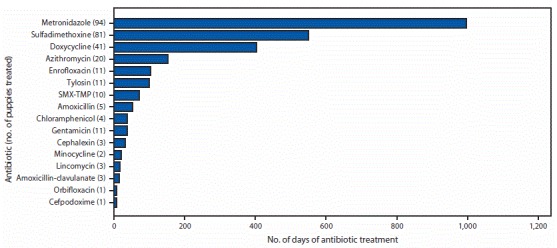
Description:Campylobacter causes an estimated 1.3 million diarrheal illnesses in the United States annually (1). In August 2017, the Florida Department of Health notified CDC of six Campylobacter jejuni infections linked to company A, a national pet store chain based in Ohio. CDC examined whole-genome sequencing (WGS) data and identified six isolates from company A puppies in Florida that were highly related to an isolate from a company A customer in Ohio. This information prompted a multistate investigation by local and state health and agriculture departments and CDC to identify the outbreak source and prevent additional illness. Health officials from six states visited pet stores to collect puppy fecal samples, antibiotic records, and traceback information. Nationally, 118 persons, including 29 pet store employees, in 18 states were identified with illness onset during January 5, 2016-February 4, 2018. In total, six pet store companies were linked to the outbreak. Outbreak isolates were resistant by antibiotic susceptibility tTesting to all antibiotics commonly used to treat Campylobacter infections, including macrolides and quinolones. Store record reviews revealed that among 149 investigated puppies, 142 (95%) received one or more courses of antibiotics, raising concern that antibiotic use might have led to development of resistance. Public health authorities issued infection Prevention recommendations to affected pet stores and recommendations for tTesting puppies to veterinarians. This outbreak demonstrates that puppies can be a source of multidrug-resistant Campylobacter infections in humans, warranting a closer look at antimicrobial use in the commercial dog industry.
-
Subjects:
-
Source:MMWR Morbidity Mortal Weekly Rep. 67(37):1032-1035.
-
Series:
-
DOI:
-
ISSN:0149-2195 (print) ; 1545-861X (digital)
-
Pubmed ID:30235182
-
Pubmed Central ID:PMC6147421
-
Document Type:
-
Place as Subject:
-
Pages in Document:4 pdf pages
-
Volume:67
-
Issue:37
-
Download URL:
-
File Type:
 [PDF - 119.16 KB]
 -
Collection(s):
-
Main Document Checksum:urn:sha-512:047c5b97a15393eff3d1039fbe2012e2f4042ca48d15dc5711745800abfb6d6a2cbb2b945db2de57ca9b2a9e867dff0ddaada4442abe79d4821a15018232d7f2
Supporting Files


 Was this page helpful?
 Found an issue?


CDC STACKS serves as an archival repository of CDC-published products including
scientific findings, journal articles, guidelines, recommendations, or other public health information authored or
co-authored by CDC or funded partners.
As a repository, CDC STACKS retains documents in their original published format to ensure public access to scientific information.
As a repository, CDC STACKS retains documents in their original published format to ensure public access to scientific information.
You May Also Like
COLLECTION
Morbidity and Mortality Weekly Report (MMWR)