



Predictive Biomarkers of Gastroesophageal Reflux Disease and Barrett's Esophagus in World Trade Center Exposed Firefighters: a 15 Year Longitudinal Study
Supporting Files
Peer Reviewed

-
2018/02/15
-
Available in CDC Stacks on 2018-02-15T00:00:00Z
File Language:
English
Details
-
Journal Article:Scientific Reports
-
Personal Author:Haider, Syed H. ; Kwon, Sophia ; Lam, Rachel ; Lee, Audrey K. ; Caraher, Erin J. ; Crowley, George ; Zhang, Liqun ; Schwartz, Theresa M. ; Zeig-Owens, Rachel ; Liu, Mengling ; Prezant, David J. ; Nolan, Anna
-
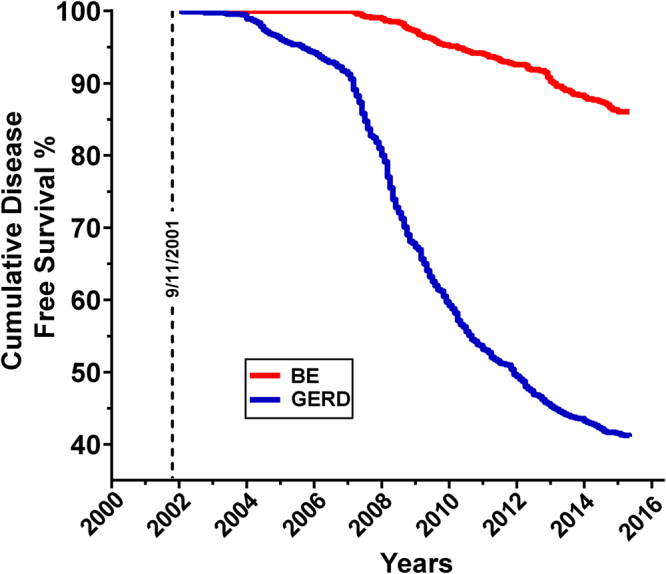
Description:Gastroesophageal reflux disease (GERD) and Barrett's Esophagus (BE), which are prevalent in the World Trade Center (WTC) exposed and general populations, negatively impact quality of life and cost of healthcare. GERD, a risk factor of BE, is linked to obstructive airways disease (OAD). We aim to identify serum biomarkers of GERD/BE, and assess the respiratory and clinical phenotype of a longitudinal cohort of never-smoking, male, WTC-exposed rescue workers presenting with pulmonary symptoms. Biomarkers collected soon after WTC-exposure were evaluated in optimized predictive models of GERD/BE. In the WTC-exposed cohort, the prevalence of BE is at least 6 times higher than in the general population. GERD/BE cases had similar lung function, D LCO, bronchodilator response and long-acting ß-agonist use compared to controls. In confounder-adjusted regression models, TNF-a > 6 pg/mL predicted both GERD and BE. GERD was also predicted by C-peptide > 360 pg/mL, while BE was predicted by fractalkine > 250 pg/mL and IP-10 > 290 pg/mL. Finally, participants with GERD had significantly increased use of short-acting ß-agonist compared to controls. Overall, biomarkers sampled prior to GERD/BE presentation showed strong predictive abilities of disease development. This study frames future investigations to further our understanding of aerodigestive pathology due to particulate matter exposure. Description provided by NIOSH
-
Subjects:
-
Keywords:
-
Source:Sci Rep 2018 Feb; 8:3106
-
ISSN:2045-2322
-
Pubmed ID:29449669
-
Pubmed Central ID:PMC5814524
-
Document Type:
-
Funding:
-
Genre:
-
Place as Subject:
-
CIO:
-
Topic:
-
Location:
-
Pages in Document:7 pdf pages
-
Volume:8
-
NIOSHTIC Number:nn:20051066
-
Email:anna.nolan@med.nyu.edu
-
Federal Fiscal Year:2018
-
Performing Organization:New York University School of Medicine
-
Peer Reviewed:True
-
Download URL:
-
File Type:
 [PDF - 1.29 MB]
 -
Collection(s):
-
Main Document Checksum:urn:sha-512:5763f0246e3cf5a874ca73ac5418c3ec23025f36dc12df2307b8edb1c04289dd390ee9bea1d530870e1e4023a5d9d9a10d6c8f3e29e76a61d04057e2746bf0ee


File Language:
English
 Was this page helpful?
 Found an issue?



CDC STACKS serves as an archival repository of CDC-published products including
scientific findings, journal articles, guidelines, recommendations, or other public health information authored or
co-authored by CDC or funded partners.
As a repository, CDC STACKS retains documents in their original published format to ensure public access to scientific information.
As a repository, CDC STACKS retains documents in their original published format to ensure public access to scientific information.
You May Also Like