



A 6-month prospective randomized controlled trial of remotely delivered group-format epilepsy self-management vs. waitlist control for high-risk people with epilepsy
Supporting Files

-
August 10 2018
-
File Language:
English
Details
-
Alternative Title:Epilepsia
-
Personal Author:
-
Description:Objective:
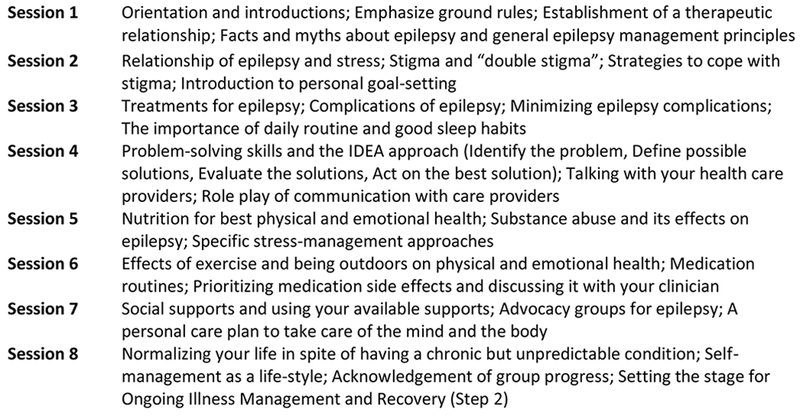
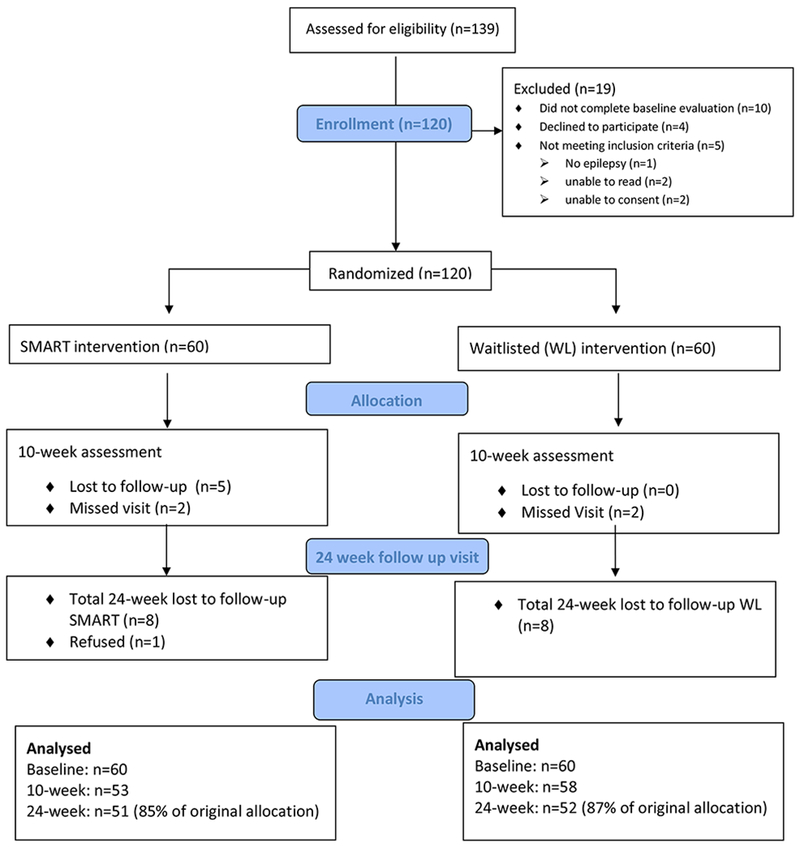
In spite of advances in care, many people with epilepsy have negative health events (NHEs) such as accidents, emergency department (ER) visits and poor quality of life. “Self-management for people with epilepsy and a history of negative health events” (SMART) is a novel group-format epilepsy self-management intervention. A community participatory approach informed the refinement of SMART which was then tested in a 6-month randomized controlled trial of SMART (N=60) vs. wait-list control (WL, N=60).
Methods:
Participants were adults ≥ age 18 with epilepsy and an NHE within the last six months (seizure, accident, self-harm attempt, ER visit, or hospitalization). Assessments were conducted at screening, baseline, 10 weeks and 24 weeks (six-months). Primary outcome was 6-month change in total NHE count. Additional outcomes included depression on the 9-item Patient Health Questionnaire (PHQ-9) and Montgomery-Asberg Depression Rating Scale (MADRS), quality of life on the 10-item Quality of Life in Epilepsy (QOLIE-10), functioning on the 36-item short-form health survey (SF-36), and seizure severity on the Liverpool Seizure Severity Scale.
Results:
Mean age was 41.3 years (SD = 11.82), 69.9% were African-American, 74.2% were unemployed and 87.4% with an annual income < U.S. $25,000. 57.5% had a seizure within 30 days of enrollment. Most NHEs were seizures. Six month study attrition was 14.2% overall and similar between arms. Individuals randomized to SMART had greater reduction in total median NHEs from baseline to 6-months compared to WL (p=.04). SMART was also associated with improved PHQ-9 (p=.032), MADRS (p= .002), QOLIE-10 (p<.001) and SF-36 (p=.015 physical health, p=.003 mental health) vs. WL. There was no difference in seizure severity.
Significance:
SMART is associated with reduced health complications and improved mood, quality of life and health functioning in high-risk people with epilepsy. Additional efforts are needed to investigate potential for scale-up.
-
Subjects:
-
Source:Epilepsia. 59(9):1684-1695
-
Pubmed ID:30098003
-
Pubmed Central ID:PMC6128290
-
Document Type:
-
Funding:
-
Volume:59
-
Issue:9
-
Collection(s):
-
Main Document Checksum:urn:sha256:89d912a0f5757e6cc6807853b8c95a5f8b3114d6bab6376cda92ea93b0c14ed9
-
Download URL:
-
File Type:
 [PDF
- 628.39 KB
]
[PDF
- 628.39 KB
]
Supporting Files


File Language:
English
 Was this page helpful?
 Found an issue?

CDC STACKS serves as an archival repository of CDC-published products including
scientific findings,
journal articles, guidelines, recommendations, or other public health information authored or
co-authored by CDC or funded partners.
As a repository, CDC STACKS retains documents in their original published format to ensure public access to scientific information.
As a repository, CDC STACKS retains documents in their original published format to ensure public access to scientific information.
You May Also Like
COLLECTION
CDC Public Access