



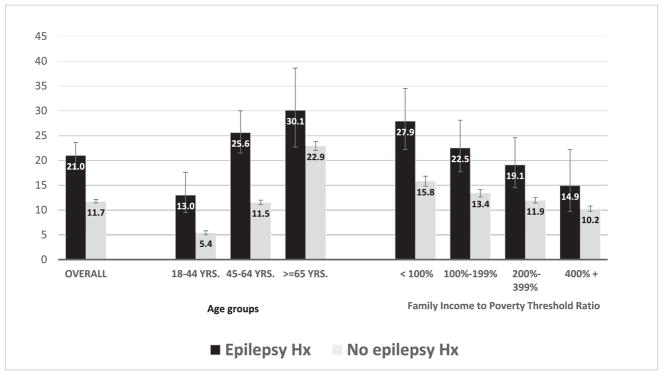
Adults with an epilepsy history, notably those 45–64 years old or at the lowest income levels, more often report heart disease than adults without an epilepsy history
Supporting Files

-
9 2018
-
Available in CDC Stacks on September 01, 2019, 12:00 AM
File Language:
English
Details
-
Alternative Title:Epilepsy Behav
-
Personal Author:
-
Description:From 95,196 sample adults in the combined 2010, 2013, and 2015 U.S. National Health Interview Survey, we estimated the association between histories of epilepsy and heart disease after accounting for sociodemographic characteristics and behavioral risk factors. Adults 18 years old or older with an epilepsy history reported heart disease (21%) about nine percentage points more often than those without such a history (12%), overall and within levels of characteristics and risk factors. These increases in heart disease history for adults with an epilepsy history compared with adults without such a history were greater in those 45-64 years old or at the lowest family income levels. These increases of heart disease in adults with an epilepsy history highlight two needs-to prevent the occurrence of heart disease and to reduce its consequences. Because comorbidity from heart disease can complicate epilepsy management, physicians caring for those with epilepsy should be aware of these increased risks, identify risk factors for heart disease, and recommend to their patients with epilepsy ways to diminish these risks.
-
Keywords:
-
Source:Epilepsy Behav. 86:208-210
-
Pubmed ID:29908906
-
Pubmed Central ID:PMC6113097
-
Document Type:
-
Funding:
-
Volume:86
-
Download URL:
-
File Type:
 [PDF - 125.75 KB]
 -
Collection(s):
-
Main Document Checksum:urn:sha256:e16aa08849b8dc2888cc590cc1aac9e64bb20c4ad0ee76fdc1096a2a22d393f8
Supporting Files


File Language:
English
 Was this page helpful?
 Found an issue?

CDC STACKS serves as an archival repository of CDC-published products including
scientific findings, journal articles, guidelines, recommendations, or other public health information authored or
co-authored by CDC or funded partners.
As a repository, CDC STACKS retains documents in their original published format to ensure public access to scientific information.
As a repository, CDC STACKS retains documents in their original published format to ensure public access to scientific information.
You May Also Like
COLLECTION
CDC Public Access