


Patterns of Prostate-Specific Antigen Test Use in the U.S., 2005–2015
Supporting Files

-
Oct 16 2017
-
File Language:
English
Details
-
Alternative Title:Am J Prev Med
-
Personal Author:
-
Description:Introduction:
Recommendations for prostate-specific antigen-based screening for prostate cancer are placing increasing emphasis on men aged 55–69 years. The goal of the current study is to describe patterns of population-based prostate-specific antigen testing with details about that age group.
Methods:
National Health Interview Surveys from 2005 to 2015 were analyzed in 2017 to estimate routine prostate-specific antigen testing in the past year from self-reported data by age group (40–54, 55–69, ≥70 years), and also by risk group, defined as African American men or men with a family history of prostate cancer versus other men. Differences between successive survey years by age and risk groups were assessed by predicted margins and rate ratios with 99% CIs, using logistic regressions.
Results:
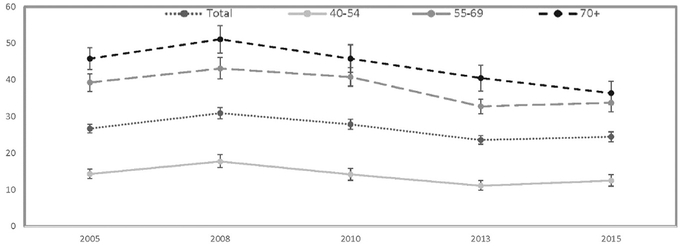
Prostate-specific antigen testing among men aged 55–69 years decreased from a high of 43.1% (95% CI=40.3, 46.1) in 2008 to a low of 32.8% (95% CI=30.8, 34.7) in 2013, with no significant change in 2015 at 33.8% (95% CI=31.3, 36.4). Men aged ≥70 years had consistently high prevalence in all survey years, ranging from 51.1% in 2008 to 36.4% in 2015. African American men, men with a family history of prostate cancer, and other men showed a 5% absolute decrease over time, but this reduction was significant only in other men.
Conclusions:
Despite decreases, the absolute change in prostate-specific antigen testing for men aged 55–69 years was small (9.3%) over the study period. Men aged ≥70 years, for whom the benefits are unlikely to exceed the harms, continue to have consistently high testing prevalence.
-
Subjects:
-
Source:Am J Prev Med. 53(6):909-913.
-
Pubmed ID:29051016
-
Pubmed Central ID:PMC6077842
-
Document Type:
-
Funding:
-
Place as Subject:
-
Volume:53
-
Issue:6
-
Collection(s):
-
Main Document Checksum:urn:sha256:ed4ae2bb50cade398a40424d3e0947dbc43c257e7724d5874a6dacc4e39bab5e
-
Download URL:
-
File Type:
 [PDF
- 246.40 KB
]
[PDF
- 246.40 KB
]
Supporting Files


File Language:
English
ON THIS PAGE



CDC STACKS serves as an archival repository of CDC-published products including
scientific findings,
journal articles, guidelines, recommendations, or other public health information authored or
co-authored by CDC or funded partners.
As a repository, CDC STACKS retains documents in their original published format to ensure public access to scientific information.
As a repository, CDC STACKS retains documents in their original published format to ensure public access to scientific information.
You May Also Like
COLLECTION
CDC Public Access