



Using a Modified Theory of Planned Behavior to Examine Adolescents’ Workplace Safety and Health Knowledge, Perceptions, and Behavioral Intention: A Structural Equation Modeling Approach
Supporting Files

-
March 31 2018
-
Available in CDC Stacks on August 01, 2019, 12:00 AM
File Language:
English
Details
-
Alternative Title:J Youth Adolesc
-
Personal Author:
-
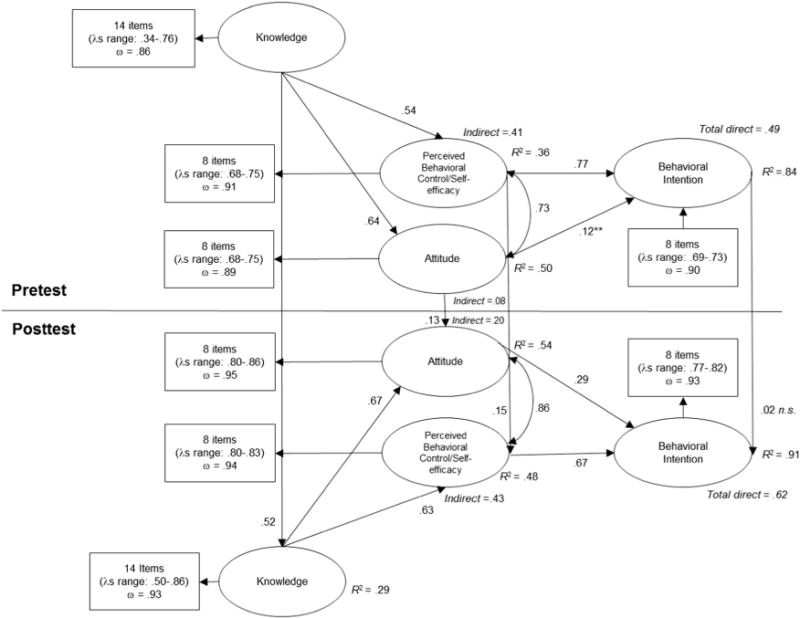
Description:Work, a defining feature of adolescence in the United States, has many benefits. Work also has risks, as adolescents experience a higher rate of serious job-related injuries compared to adults. Talking Safety, a free curriculum from the National Institute for Occupational Safety and Health, is one tool educators may adopt to provide teens with essential workplace safety and health education. Adolescents (N = 2503; female, 50.1%; Hispanic, 50.0%) in a large urban school district received Talking Safety from their eighth-grade science teachers. This study used a modified theory of planned behavior (which included a knowledge construct), to examine students' pre- and post-intervention scores on workplace safety and health knowledge, attitude, self-efficacy, and behavioral intention to enact job safety skills. The results from confirmatory factor analyses indicate three unique dimensions reflecting the theory, with a separate knowledge factor. Reliability estimates are ω ≥ .83. The findings from the structural equation models demonstrate that all paths, except pre- to posttest behavioral intention, are statistically significant. Self-efficacy is the largest contributor to the total effect of these associations. As hypothesized, knowledge has indirect effects on behavioral intention. Hispanic students scored lower at posttest on all but the behavioral intention measure, possibly suggesting the need for tailored materials to reach some teens. Overall the findings support the use of a modified theory of planned behavior to evaluate the effectiveness of a foundational workplace safety and health curriculum. This study may inform future efforts to ensure that safe and healthy work becomes integral to the adolescent experience.
-
Subjects:
- Article
- Adolescents
- Young workers
- Theory of planned behavior
- Occupational safety and health
- Injury prevention
- Structural equation modeling
- Adolescent
- Adult
- Attitude
- Female
- Health Education
- Humans
- Intention
- Latent Class Analysis
- Male
- Reproducibility of Results
- Safety
- Self Efficacy
- Students
- United States
- Workplace
-
Source:J Youth Adolesc. 47(8):1595-1610
-
Pubmed ID:29605895
-
Pubmed Central ID:PMC6065099
-
Document Type:
-
Funding:
-
Volume:47
-
Issue:8
-
Download URL:
-
File Type:
 [PDF - 474.13 KB]
 -
Collection(s):
-
Main Document Checksum:urn:sha256:3405cd4cf6fb646e06aff4b0f7acff6f445136b842a9cb2ae7b0b944b45571c0
Supporting Files


File Language:
English
 Was this page helpful?
 Found an issue?

CDC STACKS serves as an archival repository of CDC-published products including
scientific findings, journal articles, guidelines, recommendations, or other public health information authored or
co-authored by CDC or funded partners.
As a repository, CDC STACKS retains documents in their original published format to ensure public access to scientific information.
As a repository, CDC STACKS retains documents in their original published format to ensure public access to scientific information.
You May Also Like
COLLECTION
CDC Public Access