



Outbreaks Associated with Untreated Recreational Water — United States, 2000–2014
Supporting Files
Public Domain

-
Jun 29 2018
Details
-
Journal Article:Morbidity and Mortality Weekly Report (MMWR)
-
Personal Author:Graciaa, Daniel S. ; Cope, Jennifer R. ; Roberts, Virginia A. ; Cikesh, Bryanna L. ; Kahler, Amy M. ; Vigar, Marissa ; Hilborn, Elizabeth D. ; Wade, Timothy J. ; Backer, Lorraine C. ; Montgomery, Susan P. ; Secor, W. Evan ; Hill, Vincent R. ; Beach, Michael J. ; Fullerton, Kathleen E. ; Yoder, Jonathan S. ; Hlavsa, Michele C.
-
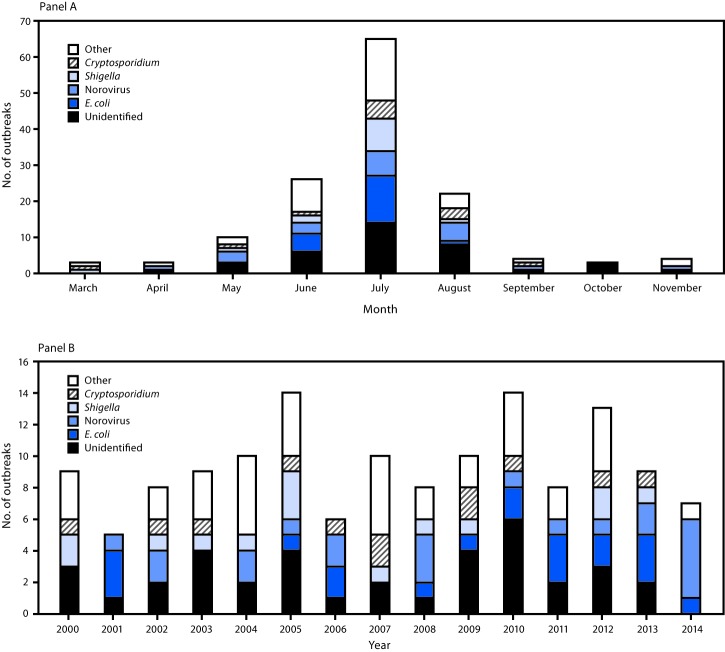
Description:Outbreaks associated with untreated recreational water can be caused by pathogens, toxins, or chemicals in fresh water (e.g., lakes, rivers) or marine water (e.g., ocean). During 2000-2014, public health officials from 35 states and Guam voluntarily reported 140 untreated recreational water-associated outbreaks to CDC. These outbreaks resulted in at least 4,958 cases of disease and two deaths. Among the 95 outbreaks with a confirmed infectious etiology, enteric pathogens caused 80 (84%); 21 (22%) were caused by noroVirus, 19 (20%) by Escherichia Coli, 14 (15%) by Shigella, and 12 (13%) by Cryptosporidium. Investigations of these 95 outbreaks identified 3,125 cases; 2,704 (87%) were caused by enteric pathogens, including 1,459 (47%) by noroVirus, 362 (12%) by Shigella, 314 (10%) by Cryptosporidium, and 155 (5%) by E. Coli. Avian schistosomes were identified as the cause in 345 (11%) of the 3,125 cases. The two deaths were in persons affected by a single outbreak (two cases) caused by Naegleria fowleri. Public parks (50 36%) and beaches (45 32%) were the leading settings associated with the 140 outbreaks. Overall, the majority of outbreaks started during June-August (113 81%); 65 (58%) started in July. Swimmers and parents of young swimmers can take steps to minimize the risk for exposure to pathogens, toxins, and chemicals in untreated recreational water by heeding posted advisories closing the beach to swimming; not swimming in discolored, smelly, foamy, or scummy water; not swimming while sick with diarrhea; and limiting water entering the nose when swimming in warm freshwater.
-
Subjects:
-
Source:MMWR Morbidity Mortal Weekly Rep. 67(25):701-706.
-
Series:
-
DOI:
-
ISSN:0149-2195 (print) ; 1545-861X (digital)
-
Pubmed ID:29953425
-
Pubmed Central ID:PMC6023190
-
Document Type:
-
Place as Subject:
-
Pages in Document:6 pdf pages
-
Volume:67
-
Issue:25
-
Download URL:
-
File Type:
 [PDF - 192.13 KB]
 -
Collection(s):
-
Main Document Checksum:urn:sha-512:5e1b31ba095ee9583d348ced7160e0ca57186c16d909966ba62237bc3ac91793414c8093467dd5f26fd936d046f0c19d65fd4d9d648a84be12c6f4d885ebcc71
Supporting Files


 Was this page helpful?
 Found an issue?


CDC STACKS serves as an archival repository of CDC-published products including
scientific findings, journal articles, guidelines, recommendations, or other public health information authored or
co-authored by CDC or funded partners.
As a repository, CDC STACKS retains documents in their original published format to ensure public access to scientific information.
As a repository, CDC STACKS retains documents in their original published format to ensure public access to scientific information.
You May Also Like
COLLECTION
Morbidity and Mortality Weekly Report (MMWR)