



Cholera Epidemic — Lusaka, Zambia, October 2017–May 2018
Supporting Files
Public Domain

-
May 18 2018
Details
-
Journal Article:Morbidity and Mortality Weekly Report (MMWR)
-
Personal Author:Sinyange, Nyambe ; Brunkard, Joan M. ; Kapata, Nathan ; Mazaba, Mazyanga Lucy ; Musonda, Kunda G. ; Hamoonga, Raymond ; Kapina, Muzala ; Kapaya, Fred ; Mutale, Lwito ; Kateule, Ernest ; Nanzaluka, Francis ; Zulu, James ; Musyani, Chileshe Lukwesa ; Winstead, Alison V. ; Davis, William W. ; N’cho, Hammad S. ; Mulambya, Nelia L. ; Sakubita, Patrick ; Chewe, Orbie ; Nyimbili, Sulani ; Onwuekwe, Ezinne V.C. ; Adrien, Nedghie ; Blackstock, Anna J. ; Brown, Travis W. ; Derado, Gordana ; Garrett, Nancy ; Kim, Sunkyung ; Hubbard, Sydney ; Kahler, Amy M. ; Malambo, Warren ; Mintz, Eric ; Murphy, Jennifer ; Narra, Rupa ; Rao, Gouthami G. ; Riggs, Margaret A. ; Weber, Nicole ; Yard, Ellen ; Zyambo, Khozya D. ; Bakyaita, Nathan ; Monze, Namani ; Malama, Kennedy ; Mulwanda, Jabbin ; Mukonka, Victor M.
-
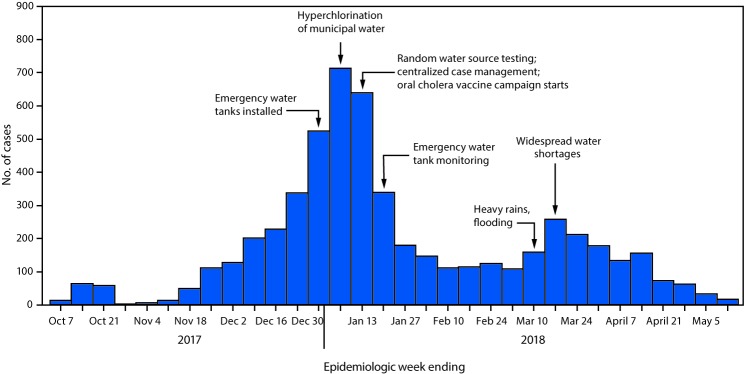
Description:On October 6, 2017, an outbreak of cholera was declared in Zambia after laboratory confirmation of Vibrio cholerae O1, biotype El Tor, serotype Ogawa, from stool specimens from two patients with acute watery diarrhea. The two patients had gone to a clinic in Lusaka, the capital city, on October 4. Cholera cases increased rapidly, from several hundred cases in early December 2017 to approximately 2,000 by early January 2018 (Figure). In collaboration with partners, the Zambia Ministry of Health (MoH) launched a multifaceted public health response that included increased chlorination of the Lusaka municipal water supply, provision of emergency water supplies, water quality monitoring and tTesting, enhanced Surveillance, epidemiologic investigations, a cholera vaccination campaign, aggressive case management and health care worker training, and laboratory tTesting of clinical samples. In late December 2017, a number of water-related preventive actions were initiated, including increasing chlorine levels throughout the city's water distribution system and placing emergency tanks of chlorinated water in the most affected neighborhoods; cholera cases declined sharply in January 2018. During January 10-February 14, 2018, approximately 2 million doses of oral cholera vaccine were administered to Lusaka residents aged ≥1 year. However, in mid-March, heavy flooding and widespread water shortages occurred, leading to a resurgence of cholera. As of May 12, 2018, the outbreak had affected seven of the 10 provinces in Zambia, with 5,905 suspected cases and a case fatality rate (CFR) of 1.9%. Among the suspected cases, 5,414 (91.7%), including 98 deaths (CFR = 1.8%), occurred in Lusaka residents.
-
Subjects:
-
Source:MMWR Morbidity Mortal Weekly Rep. 67(19):556-559.
-
Series:
-
DOI:
-
ISSN:0149-2195 (print) ; 1545-861X (digital)
-
Pubmed ID:29771877
-
Pubmed Central ID:PMC6048949
-
Document Type:
-
Place as Subject:
-
Pages in Document:4 pdf pages
-
Volume:67
-
Issue:19
-
Download URL:
-
File Type:
 [PDF - 107.76 KB]
 -
Collection(s):
-
Main Document Checksum:urn:sha-512:71a8126b725268c71c13b6c6688964b227da2f4b5c10624347592339858d4401c4bbaee7f4fcc55490c17004380646f8114be394a3f4ff3dddd5ed4459ed7a30
Supporting Files


 Was this page helpful?
 Found an issue?

CDC STACKS serves as an archival repository of CDC-published products including
scientific findings, journal articles, guidelines, recommendations, or other public health information authored or
co-authored by CDC or funded partners.
As a repository, CDC STACKS retains documents in their original published format to ensure public access to scientific information.
As a repository, CDC STACKS retains documents in their original published format to ensure public access to scientific information.
You May Also Like
COLLECTION
Morbidity and Mortality Weekly Report (MMWR)