


Maternal ambient heat exposure during early pregnancy in summer and spring and congenital heart defects – A large US population-based, case-control study
Supporting Files

-
9 2018
-
File Language:
English
Details
-
Alternative Title:Environ Int
-
Personal Author:Lin, Shao ; Lin, Ziqiang ; Ou, Yanqiu ; Soim, Aida ; Shrestha, Srishti ; Lu, Yi ; Sheridan, Scott ; Luben, Thomas J. ; Fitzgerald, Edward ; Bell, Erin ; Shaw, Gary M. ; Reefhuis, Jennita ; Langlois, Peter H. ; Romitti, Paul ; Feldkamp, Marcia L. ; Malik, Sadia ; Pantea, Cristian ; Nayak, Seema ; Hwang, Syni-An ; Browne, Marilyn
-
Corporate Authors:
-
Description:Background/objective
Few studies have assessed the effect of ambient heat during the fetal development period on congenital heart defects (CHDs), especially in transitional seasons. We examined and compared the associations between extreme heat and CHD phenotypes in summer and spring, assessed their geographical differences, and compared different heat indicators.
Methods
We identified 5848 CHD cases and 5742 controls (without major structural defects) from the National Birth Defects Prevention Study, a US multicenter, population-based case-control study. Extreme heat events (EHEs) were defined by using the 95th (EHE95) or 90th (EHE90) percentile of daily maximum temperature and its frequency and duration during postconceptional weeks 3–8. We used a two-stage Bayesian hierarchical model to examine both regional and study-wide associations. Exposure odds ratios (ORs) were calculated using multivariate logistic regression analyses, while controlling for potential confounding factors.
Results
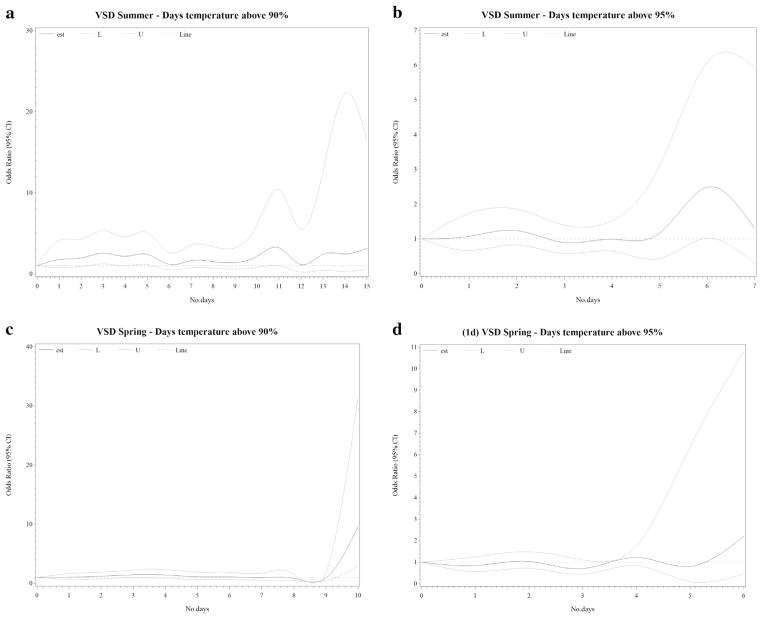
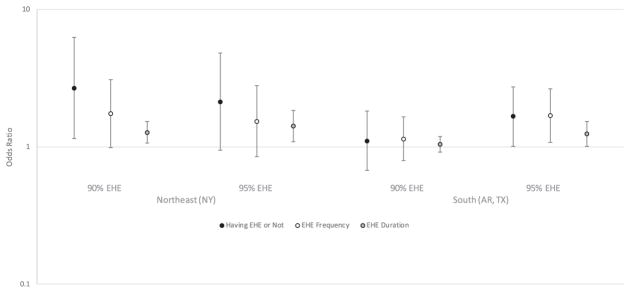
Overall, we observed no significant relationships between maternal EHE exposure and CHDs in most regions during summer. However, we found that 3–11 days of EHE90 during summer and spring was significantly associated with ventricular septal defects (VSDs) study-wide (ORs ranged: 2.17–3.24). EHE95 in spring was significantly associated with conotruncal defects and VSDs in the South (ORs: 1.23–1.78). Most EHE indicators in spring were significantly associated with increased septal defects (both VSDs and atrial septal defects (ASDs)) in the Northeast.
Conclusion
While generally null results were found, long duration of unseasonable heat was associated with the increased risks for VSDs and ASDs, mainly in South and Northeast of the US. Further research to confirm our findings is needed.
-
Subjects:
-
Keywords:
-
Source:Environ Int. 118:211-221
-
Pubmed ID:29886237
-
Pubmed Central ID:PMC6045445
-
Document Type:
-
Funding:
-
Place as Subject:
-
Volume:118
-
Collection(s):
-
Main Document Checksum:urn:sha256:4d3afd38da545c087b8fa56924e7517c91f9d3eb83ad9f714da37ca35e0b2b2a
-
Download URL:
-
File Type:
 [PDF
- 354.83 KB
]
[PDF
- 354.83 KB
]
Supporting Files


File Language:
English
ON THIS PAGE




CDC STACKS serves as an archival repository of CDC-published products including
scientific findings,
journal articles, guidelines, recommendations, or other public health information authored or
co-authored by CDC or funded partners.
As a repository, CDC STACKS retains documents in their original published format to ensure public access to scientific information.
As a repository, CDC STACKS retains documents in their original published format to ensure public access to scientific information.
You May Also Like
COLLECTION
CDC Public Access