


Seroprevalence of Histoplasmosis in Somali, Burmese, and Hmong Refugees Residing in Thailand and Kenya
Supporting Files

-
Apr 2018
-
File Language:
English
Details
-
Personal Author:
-
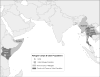
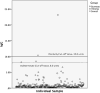
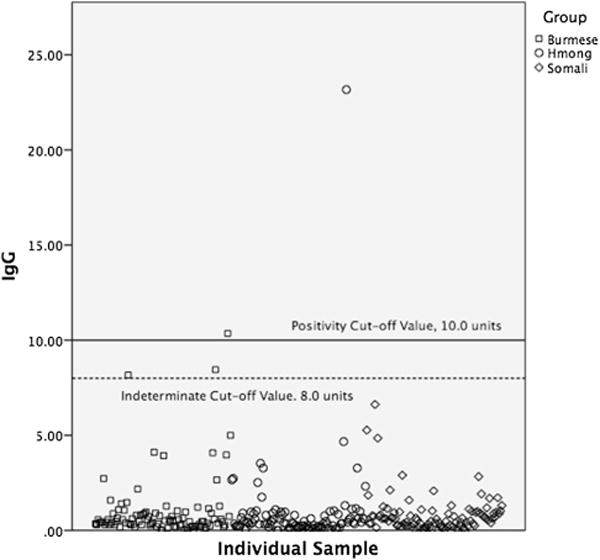
Description:Histoplasmosis is known to be endemic to the Midwestern United States, but cases have been reported throughout much of the world. Somali, Hmong, and Burmese (ethnically Karen) persons make up some of the largest refugee populations coming the United States in recent years. Yet, information about risk of Histoplasma capsulatum infection amongst these populations is limited. This study used the CDC Migrant Serum Bank to test ~100 samples from each of Somali, Burmese, and Hmong U.S.-bound refugees. Samples were tested by enzyme immunoassay for Histoplasma capsulatum IgG. Overall 1% (2/299) of refugee serum samples were positive for H. capsulatum IgG. One of 99 samples obtained from Hmong refugees was positive, and the other positive sample came from among 100 Burmese refugee samples. H capsulatum IgG positivity was detected at low levels in Hmong and Burmese refugees. No IgG positivity was detected among 100 Somali refugees.
-
Subjects:
-
Source:J Immigr Minor Health. 20(2):334-338
-
Pubmed ID:28474198
-
Pubmed Central ID:PMC6044430
-
Document Type:
-
Funding:R01 NS086312/NS/NINDS NIH HHS/United States ; CC999999/Intramural CDC HHS/United States ; T32 AI055433/AI/NIAID NIH HHS/United States ; R25TW009345/Fogarty International Center/ ; R01NS086312/National Institute of Neurological Disorders and Stroke/ ; R25 TW009345/TW/FIC NIH HHS/United States ; T32AI055433/National Institute of Allergy and Infectious Diseases/
-
Place as Subject:
-
Volume:20
-
Issue:2
-
Collection(s):
-
Main Document Checksum:urn:sha256:5b8ac27aa0ca09b8c4c1248bc3a3ccbba491f24efeea692f25e2e51a5a0c9d19
-
Download URL:
-
File Type:
 [PDF
- 156.52 KB
]
[PDF
- 156.52 KB
]
Supporting Files


File Language:
English
ON THIS PAGE


CDC STACKS serves as an archival repository of CDC-published products including
scientific findings,
journal articles, guidelines, recommendations, or other public health information authored or
co-authored by CDC or funded partners.
As a repository, CDC STACKS retains documents in their original published format to ensure public access to scientific information.
As a repository, CDC STACKS retains documents in their original published format to ensure public access to scientific information.
You May Also Like
COLLECTION
CDC Public Access