



Effect of Age at Vaccination on Rotavirus Vaccine Effectiveness in Bolivian Infants
Supporting Files

-
2018/08/01
-
Available in CDC Stacks on 2019-08-01T00:00:00Z
File Language:
English
Details
-
Alternative Title:Pediatr Infect Dis J
-
Personal Author:
-
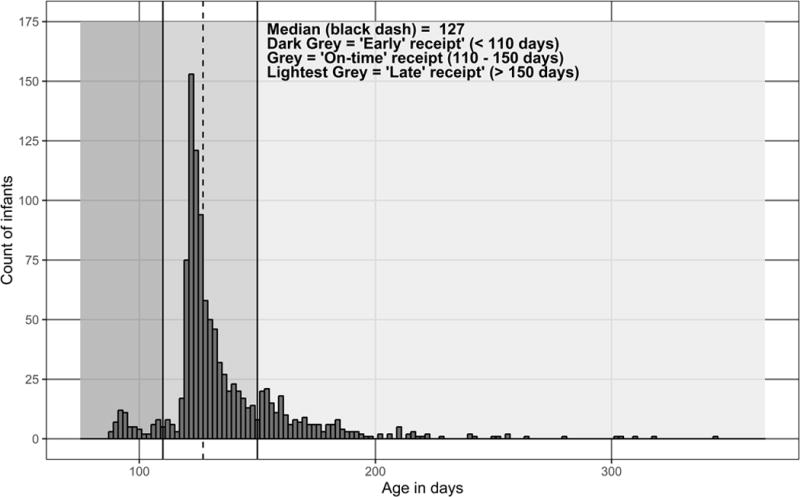
Description:Background ; Rotavirus vaccines are less effective in developing countries versus developed countries. One hypothesis for this difference in performance is that higher levels of maternal antibodies in developing countries may interfere with vaccine response, suggesting that delayed dosing could be beneficial. The present analysis aims to assess whether rotavirus vaccine effectiveness (VE) varies by age at vaccination during routine use in Bolivia. ; Methods ; Data were merged from two post-licensure evaluations of monovalent rotavirus vaccine (RV1) in Bolivia, where two doses of RV1 are recommended at two and four months of age. For each dose, children were classified as receiving each dose "early," "on-time," or "late." Stratified unconditional logistic regression models were used to estimate VE, using unvaccinated children as the referent. VE was calculated as (1 - odds ratio) × 100%. Models were adjusted for hospital, age, and time since RV1 introduction (via including terms for month and year of birth). ; Results ; VE for two doses of RV1 tended to be higher in infants receiving the first dose early (VE 92%; 95% confidence interval CI 70%, 98%), when compared to infants receiving their first dose on time (72% 62%, 81%) or late (68% 51%, 79%). Estimates of VE were not substantially different when comparing children by age at second dose (early: VE 76% 50%, 89%; on time: VE 70% 50%, 89%; late: VE 75% 60%, 84%), including all children. ; Conclusions ; Our results indicate that early administration may improve VE and support the current WHO recommendations for the RV1 schedule.
-
Subjects:
-
Source:Pediatr Infect Dis J. 37(8):e216-e221
-
Pubmed ID:29341984
-
Pubmed Central ID:PMC6043377
-
Document Type:
-
Funding:
-
Genre:
-
Place as Subject:
-
Volume:37
-
Issue:8
-
Download URL:
-
File Type:
 [PDF - 202.82 KB]
 -
Collection(s):
-
Main Document Checksum:urn:sha-512:2275d1ea4363592f52a17aa3a4a3ecef95082a506449a62c36b82ac7cf3ced78c2ee764f7ade09158defea9ac12aab585e8572d0e98eb4829dc7c3a9bdbc79b2
Supporting Files


File Language:
English
 Was this page helpful?
 Found an issue?


CDC STACKS serves as an archival repository of CDC-published products including
scientific findings, journal articles, guidelines, recommendations, or other public health information authored or
co-authored by CDC or funded partners.
As a repository, CDC STACKS retains documents in their original published format to ensure public access to scientific information.
As a repository, CDC STACKS retains documents in their original published format to ensure public access to scientific information.
You May Also Like
COLLECTION
CDC Public Access