



Food Insecurity, CKD, and Subsequent ESRD in US Adults
Supporting Files

-
7 2017 ; 7-2017
-
Available in CDC Stacks on 2018-07-01T00:00:00Z
File Language:
English
Details
-
Alternative Title:Am J Kidney Dis
-
Personal Author:
-
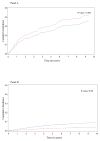
Description:Background ; Poor access to food among low income adults has been recognized as a risk factor for CKD, but there is no data on the impact of food insecurity on progression to ESRD. We hypothesized that food insecurity would be independently associated with risk of ESRD among persons with and without CKD. ; Study Design ; Longitudinal cohort study ; Setting & Participants ; 2,320 adults (≥20 years) with CKD and 10,448 adults with ‘No-CKD’ enrolled in NHANES III (1988–1994) with household income ≤400% of the federal poverty level linked to Medicare ESRD Registry for a median follow-up period of 12 years. ; Predictor ; Food insecurity, defined as an affirmative response to the food insecurity screening question. ; Outcome ; Development of treated ESRD. ; Measurements ; Demographics, income, diabetes, hypertension, eGFR, and albuminuria. DAL was estimated from the 24-hr dietary recall. We used a Fine-Gray competing risk model to estimate the relative hazard RH for ESRD associated with food insecurity after adjusting for covariates. ; Results ; 4.5% adults with CKD were food insecure. Food insecure individuals were more likely to be younger, have diabetes (29.9%) and hypertension (73.9%), or have albuminuria (90.4%) as compared to their counterparts (V p<0.05). Median DAL in the food secure vs. food insecure group was 51.2 mEq/day vs 55.6 mEq/day, respectively (p=0.05). Food insecure adults were more likely to develop ESRD (RH 95% CI: 1.38 1.08–3.10) compared to food secure adults after adjustment for demographics, income, diabetes, hypertension, eGFR and albuminuria. In the No-CKD group, 5.7% were food insecure. Here, we did not find a significant association between food insecurity and ESRD (0.77 0.40–1.49). ; Limitations ; use of a single 24-hr diet recall, lack of laboratory follow-up data, and measure of changes in food insecurity over time; follow-up of the cohort ended 10 years ago. ; Conclusion ; Among individuals with CKD, food insecurity was independently associated with a higher likelihood of developing ESRD. Innovative approaches to address food insecurity should be tested for their impact on CKD outcomes.
-
Subjects:
-
Source:Am J Kidney Dis. 70(1):38-47
-
Pubmed ID:28215947
-
Pubmed Central ID:PMC5765854
-
Document Type:
-
Funding:
-
Volume:70
-
Issue:1
-
Download URL:
-
File Type:
 [PDF - 503.39 KB]
 -
Collection(s):
-
Main Document Checksum:urn:sha256:047e8f6613fa623fa884f70c14da762ab8016e0ad8cd2b1472bc5e7e4d928cba
Supporting Files


File Language:
English
 Was this page helpful?
 Found an issue?


CDC STACKS serves as an archival repository of CDC-published products including
scientific findings, journal articles, guidelines, recommendations, or other public health information authored or
co-authored by CDC or funded partners.
As a repository, CDC STACKS retains documents in their original published format to ensure public access to scientific information.
As a repository, CDC STACKS retains documents in their original published format to ensure public access to scientific information.
You May Also Like
COLLECTION
CDC Public Access