


The Environment and Reproductive Health (EARTH) Study: A Prospective Preconception Cohort
Supporting Files

-
Feb 20 2018
-
File Language:
English
Details
-
Alternative Title:Hum Reprod Open
-
Personal Author:Messerlian, Carmen ; Williams, Paige L. ; Ford, Jennifer B. ; Chavarro, Jorge E. ; Mínguez-Alarcón, Lidia ; Dadd, Ramace ; Braun, Joseph M. ; Gaskins, Audrey J. ; Meeker, John D. ; James-Todd, Tamarra ; Chiu, Yu-Han ; Nassan, Feiby L. ; Souter, Irene ; Petrozza, John ; Keller, Myra ; Toth, Thomas L. ; Calafat, Antonia M. ; Hauser, Russ
-
Corporate Authors:
-
Description:Background
The Environment and Reproductive Health (EARTH) Study is an ongoing prospective preconception cohort designed to investigate the impact of environmental, nutritional, and lifestyle factors among both women and men on fertility and pregnancy outcomes.
Methods
The EARTH Study recruits women 18 to 45 years and men 18 to 55 years seeking fertility evaluation and treatment at the Massachusetts General Hospital (MGH) Fertility Center, Boston, USA. Women and men are eligible to join either independently or as a couple. Participants are followed from study entry throughout each fertility treatment cycle, once per trimester of pregnancy (for those achieving pregnancy), and up to labor and delivery, or until they discontinue treatment or withdraw from the study. The study collects biological samples, self-reported questionnaire data (including a food frequency questionnaire) and clinically abstracted information.
Results
As of June 2017, the study cohort included 799 women and 487 men (447 couples; 40 men joined without female partners). Women were on average 34.7 years old at time of enrolment and predominantly Caucasian (81%), educated (49% have a graduate degree), and nulliparous (83%). Men were on average 36.6 years at baseline and mostly Caucasian (86%) and never-smokers (67%).
Conclusions
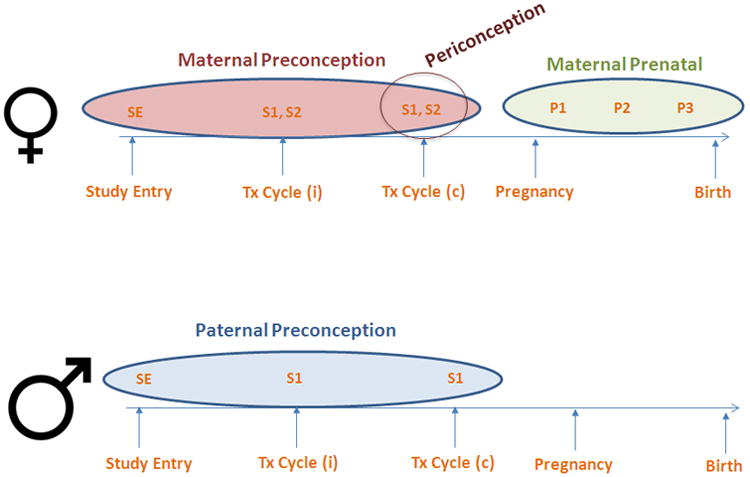
The EARTH Study is one of the few cohorts designed to examine multiple potentially critical windows of vulnerability, including the paternal and maternal preconception windows and the periconception and prenatal windows in pregnancy. It is also one of the few human studies that has assessed potential interactions between environmental exposures and dietary factors.
-
Subjects:
-
Source:Hum Reprod Open. 2018(2)
-
Pubmed ID:29888739
-
Pubmed Central ID:PMC5990043
-
Document Type:
-
Funding:R01 OH008578/OH/NIOSH CDC HHS/United States ; R00 ES020346/ES/NIEHS NIH HHS/United States ; P30 ES000002/ES/NIEHS NIH HHS/United States ; R01 ES009718/ES/NIEHS NIH HHS/United States ; P30 ES017885/ES/NIEHS NIH HHS/United States ; K99 ES020346/ES/NIEHS NIH HHS/United States ; R01 ES022955/ES/NIEHS NIH HHS/United States ; K99 ES026648/ES/NIEHS NIH HHS/United States
-
Volume:2018
-
Issue:2
-
Collection(s):
-
Main Document Checksum:urn:sha-512:e9db7e71f558d20ac1ed59b74eea9a481c6b223d024e6821ff7914c139e8bc266fcc97043af64931b073fe4da5bf1b5b3a25730b5631dcf8c64af756d36de08d
-
Download URL:
-
File Type:
 [PDF
- 487.85 KB
]
[PDF
- 487.85 KB
]
Supporting Files


File Language:
English
ON THIS PAGE


CDC STACKS serves as an archival repository of CDC-published products including
scientific findings,
journal articles, guidelines, recommendations, or other public health information authored or
co-authored by CDC or funded partners.
As a repository, CDC STACKS retains documents in their original published format to ensure public access to scientific information.
As a repository, CDC STACKS retains documents in their original published format to ensure public access to scientific information.
You May Also Like
COLLECTION
CDC Public Access