



Methadone Prescribing and Overdose and the Association with Medicaid Preferred Drug List Policies — United States, 2007–2014
Supporting Files
Public Domain

-
Mar 31 2017
Details
-
Journal Article:Morbidity and Mortality Weekly Report (MMWR)
-
Personal Author:
-
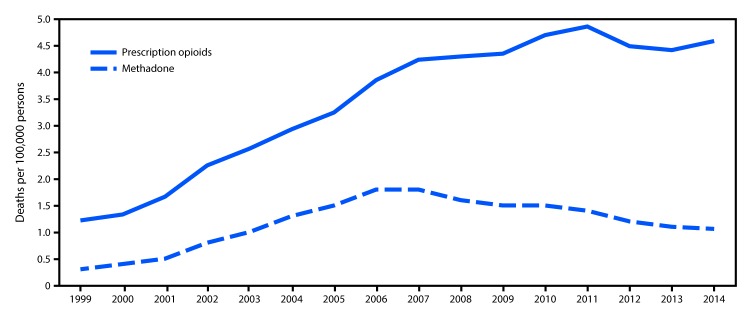
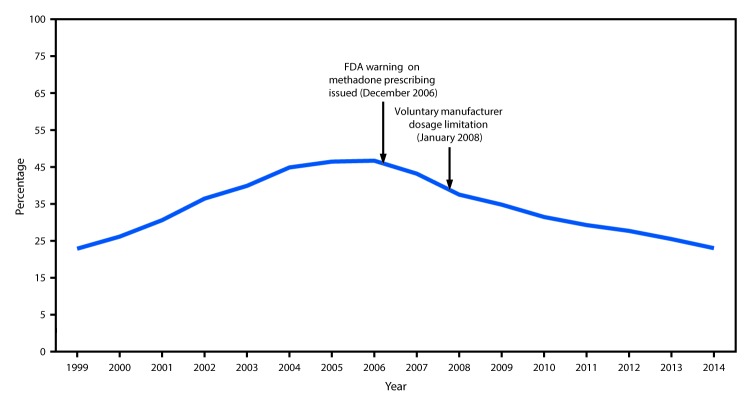
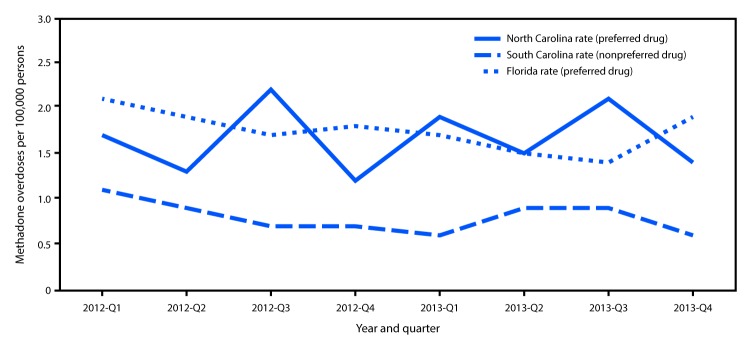
Description:Drug overdose is a leading cause of injury death in the United States; 47,055 fatal drug overdoses were reported in 2014, a 6.5% increase from the previous year (1), driven by opioid use disorder (2,3). Methadone is an opioid prescribed for pain management and is also provided through opioid treatment programs to treat opioid use disorders. Because methadone might remain in a person's system long after the pain-relieving benefits have been exhausted, it can cause slow or shallow breathing and dangerous changes in heartbeat that might not be perceived by the patient (4,5). In December 2006, the Food and Drug Administration issued a Public Health Advisory that alerted health care professionals to reports of death and life-threatening adverse events, such as respiratory depression and cardiac arrhythmias, in patients receiving methadone (4); in January 2008, a voluntary manufacturer restriction limited distribution of the 40 mg formulation of methadone.* CDC analyzed state Mortality and health care data and preferred drug list (PDL) policies to 1) compare the percentage of deaths involving methadone with the rate of prescribing methadone for pain, 2) characterize variation in methadone prescribing among payers and states, and 3) assess whether an association existed between state Medicaid reimbursement PDL policies and methadone overdose rates. The analyses found that, from 2007 to 2014, large declines in methadone-related overdose deaths occurred. Prescriptions for methadone accounted for 0.85% of all opioid prescriptions for pain in the commercially insured population and 1.1% in the Medicaid population. In addition, an association was observed between Medicaid PDLs requiring prior authorization for methadone and lower rates of methadone overdose among Medicaid enrollees. PDL policies requiring prior authorization might help to reduce the number of methadone overdoses.
-
Subjects:
-
Source:MMWR Morbidity Mortal Weekly Rep. 66(12):320-323.
-
Series:
-
DOI:
-
ISSN:0149-2195 (print) ; 1545-861X (digital)
-
Pubmed ID:28358791
-
Pubmed Central ID:PMC5657959
-
Document Type:
-
Place as Subject:
-
Pages in Document:4 pdf pages
-
Volume:66
-
Issue:12
-
Download URL:
-
File Type:
 [PDF - 211.21 KB]
 -
Collection(s):
-
Main Document Checksum:urn:sha-512:de834f27c4c5deac7b83084888652d21d3ce336d74a0ef167f8b436629ab823aa7f004808f546427f8ea612bd13003d5af5ed90607ee36396f842ada3fbe76c0
Supporting Files


 Was this page helpful?
 Found an issue?



CDC STACKS serves as an archival repository of CDC-published products including
scientific findings, journal articles, guidelines, recommendations, or other public health information authored or
co-authored by CDC or funded partners.
As a repository, CDC STACKS retains documents in their original published format to ensure public access to scientific information.
As a repository, CDC STACKS retains documents in their original published format to ensure public access to scientific information.
You May Also Like
COLLECTION
Morbidity and Mortality Weekly Report (MMWR)