


Enabling clinicians to easily find location-based travel health recommendations—is innovation needed?
Supporting Files

-
1 01 2018
-
File Language:
English
Details
-
Alternative Title:J Travel Med
-
Personal Author:
-
Description:Background
The types of place names and the level of geographic detail that patients report to clinicians regarding their intended travel itineraries vary. The reported place names may not match those in published travel health recommendations, making traveler-specific recommendations potentially difficult and time-consuming to identify. Most published recommendations are at the country level; however, subnational recommendations exist when documented disease risk varies within a country, as for malaria and yellow fever. Knowing the types of place names reported during consultations would be valuable for developing more efficient ways of searching and identifying recommendations, hence we inventoried these descriptors and identified patterns in their usage.
Methods
The data analyzed were previously collected individual travel itineraries from pretravel consultations performed at Global TravEpiNet (GTEN) travel clinic sites. We selected a clinic-stratified random sample of records from 18 GTEN clinics that contained responses to an open-ended question describing itineraries. We extracted and classified place names into nine types and analyzed patterns relative to common travel-related demographic variables.
Results
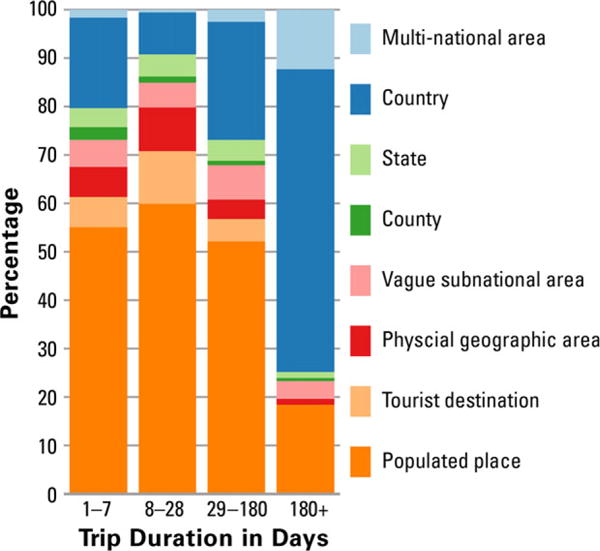
From the 1756 itineraries sampled, 1570 (89%) included one or more place names, totaling 3366 place names. The frequency of different types of place names varied considerably: 2119 (63%) populated place, 336 (10%) tourist destination, 283 (8%) physical geographic area, 206 (6%) vague subnational area, 163 (5%) state, 153 (5%) country, 48 (1%) county, 12 (1%) undefined.
Conclusions
The types of place names used by travelers to describe travel itineraries during pretravel consultations were often different from the ones referenced in travel health recommendations. This discrepancy means that clinicians must use additional maps, atlases or online search tools to cross-reference the place names given to the available recommendations. Developing new clinical tools that use geographic information systems technology would make it easier and faster for clinicians to find applicable recommendations for travelers.
-
Keywords:
-
Source:J Travel Med. 25(1)
-
Pubmed ID:29788401
-
Pubmed Central ID:PMC5991802
-
Document Type:
-
Funding:
-
Volume:25
-
Issue:1
-
Collection(s):
-
Main Document Checksum:urn:sha256:b82b517115d75473db37f4bfd21b8e05c350e3eadca7a0a2a52b51939f361cba
-
Download URL:
-
File Type:
 [PDF
- 111.57 KB
]
[PDF
- 111.57 KB
]
Supporting Files


File Language:
English
ON THIS PAGE

CDC STACKS serves as an archival repository of CDC-published products including
scientific findings,
journal articles, guidelines, recommendations, or other public health information authored or
co-authored by CDC or funded partners.
As a repository, CDC STACKS retains documents in their original published format to ensure public access to scientific information.
As a repository, CDC STACKS retains documents in their original published format to ensure public access to scientific information.
You May Also Like
COLLECTION
CDC Public Access