



Potential Confounding of Diagnosis of Rabies in Patients with Recent Receipt of Intravenous Immune Globulin
Supporting Files
Public Domain

-
Feb 09 2018
Details
-
Journal Article:Morbidity and Mortality Weekly Report (MMWR)
-
Personal Author:Vora, Neil M. ; Orciari, Lillian A. ; Bertumen, J Bradford ; Damon, Inger ; Ellison, James A. ; Fowler, Vance G. ; Franka, Richard ; Petersen, Brett W. ; Satheshkumar, P.S. ; Schexnayder, Stephen M. ; Smith, Todd G. ; Wallace, Ryan M. ; Weinstein, Susan ; Williams, Carl ; Yager, Pamela ; Niezgoda, Michael
-
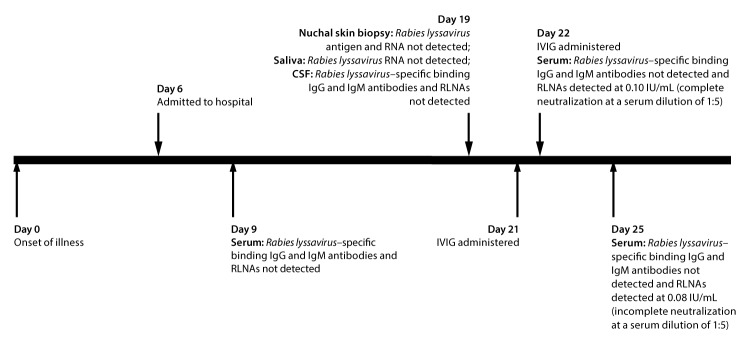
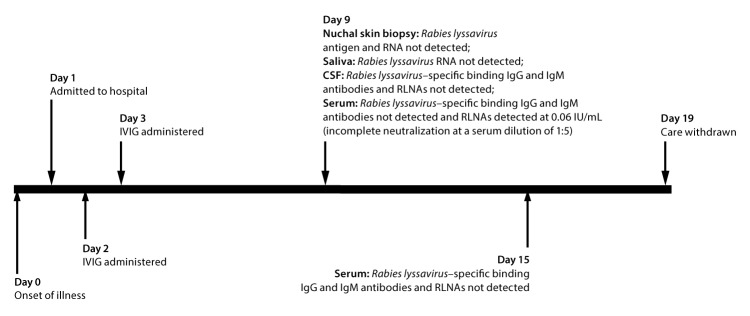
Description:Rabies is an acute encephalitis that is nearly always fatal. It is caused by infection with Viruses of the genus LyssaVirus, the most common of which is Rabies lyssaVirus. The Council of State and Territorial Epidemiologists (CSTE) defines a confirmed human rabies case as an illness compatible with rabies that meets at least one of five different laboratory criteria.* Four of these criteria do not depend on the patient's rabies vaccination status; however, the remaining criterion, "identification of LyssaVirus-specific antibody (i.e. by indirect fluorescent antibody…test or complete Rabies lyssaVirus neutralization at 1:5 dilution) in the serum," is only considered diagnostic in unvaccinated patients. LyssaVirus-specific antibodies include Rabies lyssaVirus-specific binding immunoglobulin G (IgG) and immunoglobulin M (IgM) antibodies and Rabies lyssaVirus neutralizing antibodies (RLNAs). This report describes six patients who were tested for rabies by CDC and who met CSTE criteria for confirmed human rabies because they had illnesses compatible with rabies, had not been vaccinated for rabies, and were found to have serum RLNAs (with complete Rabies lyssaVirus neutralization at a serum dilution of 1:5). An additional four patients are described who were tested for rabies by CDC who were found to have serum RLNAs (with incomplete Rabies lyssaVirus neutralization at a serum dilution of 1:5) despite having not been vaccinated for rabies. None of these 10 patients received a rabies Diagnosis; rather, they were considered to have been passively immunized against rabies through recent receipt of intravenous immune globulin (IVIG). Serum RLNA test results should be interpreted with caution in patients who have not been vaccinated against rabies but who have recently received IVIG.
-
Subjects:
-
Source:MMWR Morbidity Mortal Weekly Rep. 67(5):161-165.
-
Series:
-
DOI:
-
ISSN:0149-2195 (print) ; 1545-861X (digital)
-
Pubmed ID:29420464
-
Pubmed Central ID:PMC5812472
-
Document Type:
-
Pages in Document:5 pdf pages
-
Volume:67
-
Issue:5
-
Download URL:
-
File Type:
 [PDF - 274.61 KB]
 -
Collection(s):
-
Main Document Checksum:urn:sha-512:218726c3a1fc739d98e657a7e3c6c39398b4fc231242bda9bc93fe28096070d45cd373a0bec4e2d2ff45d216a0e4cce07db893937329f35a667bc8b2c958e1f7
Supporting Files


 Was this page helpful?
 Found an issue?


CDC STACKS serves as an archival repository of CDC-published products including
scientific findings, journal articles, guidelines, recommendations, or other public health information authored or
co-authored by CDC or funded partners.
As a repository, CDC STACKS retains documents in their original published format to ensure public access to scientific information.
As a repository, CDC STACKS retains documents in their original published format to ensure public access to scientific information.
You May Also Like
COLLECTION
Morbidity and Mortality Weekly Report (MMWR)