



Vital Signs: Alcohol Poisoning Deaths — United States, 2010–2012
Supporting Files
Public Domain

-
Jan 09 2015
Details
-
Alternative Title:Alcohol Poisoning Deaths — United States, 2010–2012
-
Journal Article:Morbidity and Mortality Weekly Report (MMWR)
-
Personal Author:
-
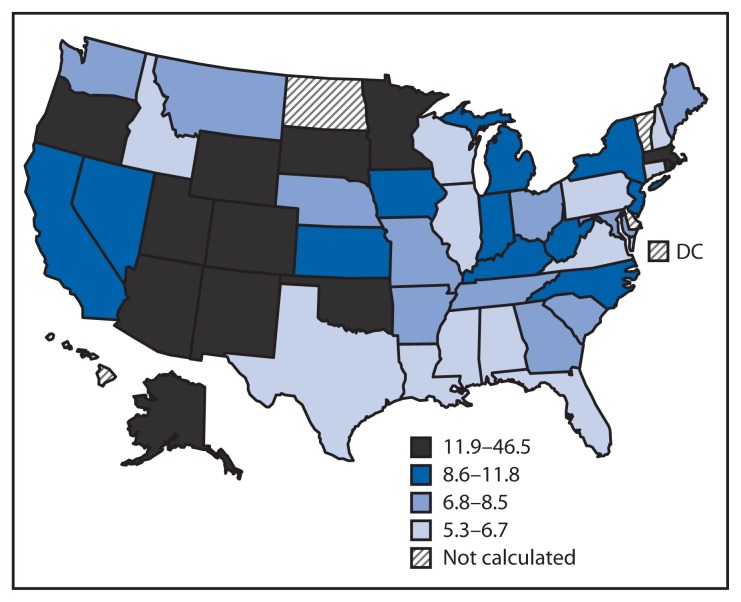
Description:Background ; Alcohol Poisoning is typically caused by binge drinking at high intensity (i.e., consuming a very large amount of alcohol during an episode of binge drinking). Approximately 38 million U.S. adults report binge drinking an average of four times per month and consuming an average of eight drinks per episode. ; Methods ; CDC analyzed data for 2010–2012 from the National Vital Statistics System (U.S.) to assess average annual alcohol Poisoning deaths and death rates (ICD-10 codes X45 and Y15; underlying cause of death) in the United States among persons aged ≥15 years, by sex, age group, race/ethnicity, and state. ; Results ; During 2010–2012, an annual average of 2,221 alcohol Poisoning deaths (8.8 deaths per 1 million population) occurred among persons aged ≥15 years in the United States Of those deaths, 1,681 (75.7%) involved adults aged 35–64 years, and 1,696 (76.4%) involved men. Although non-Hispanic whites accounted for the majority of alcohol Poisoning deaths (67.5%; 1,500 deaths), the highest age-adjusted death rate was among American Indians/Alaska Natives (49.1 per 1 million). The age-adjusted rate of alcohol Poisoning deaths in states ranged from 5.3 per 1 million in Alabama to 46.5 per 1 million in Alaska. ; Conclusions ; On average, six persons, mostly adult men, die from alcohol Poisoning each day in the United States Alcohol Poisoning death rates vary substantially by state. ; Implications for Public Health Practice ; Evidence-based strategies for preventing excessive drinking (e.g., regulating alcohol outlet density and preventing illegal alcohol sales in retail settings) could reduce alcohol Poisoning deaths by reducing the prevalence, frequency, and intensity of binge drinking.
-
Subjects:
-
Source:MMWR Morbidity Mortal Weekly Rep. 2015; 63(53):1238-1242.
-
Series:
-
ISSN:0149-2195 (print) ; 1545-861X (digital)
-
Pubmed ID:25577989
-
Pubmed Central ID:PMC4646044
-
Document Type:
-
Corporate as Subject:
-
Place as Subject:
-
Pages in Document:5 pdf pages
-
Volume:63
-
Issue:53
-
Download URL:
-
File Type:
 [PDF - 265.26 KB]
 -
Collection(s):
-
Main Document Checksum:urn:sha-512:bf64ec5e4b3211420734837882615233e7513b2592a7c012417ca4e3aa259a5e611c01f372184390c257741064456c3b7a8978b576f9d9b44dbd6c1a7d7d4a37
Supporting Files


 Was this page helpful?
 Found an issue?

CDC STACKS serves as an archival repository of CDC-published products including
scientific findings, journal articles, guidelines, recommendations, or other public health information authored or
co-authored by CDC or funded partners.
As a repository, CDC STACKS retains documents in their original published format to ensure public access to scientific information.
As a repository, CDC STACKS retains documents in their original published format to ensure public access to scientific information.
You May Also Like
COLLECTION
Morbidity and Mortality Weekly Report (MMWR)