



Vital Signs: Fruit and Vegetable Intake Among Children — United States, 2003–2010
Supporting Files
Public Domain

-
Aug 08 2014
Details
-
Alternative Title:Fruit and Vegetable Intake Among Children — United States, 2003–2010
-
Journal Article:Morbidity and Mortality Weekly Report (MMWR)
-
Personal Author:
-
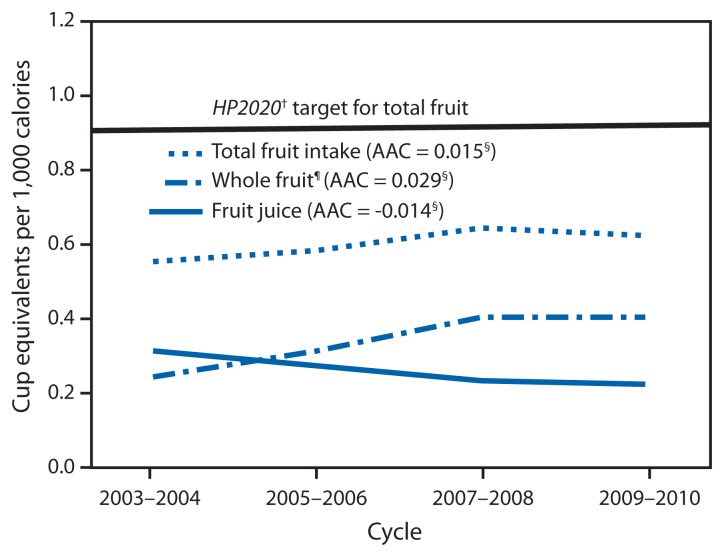
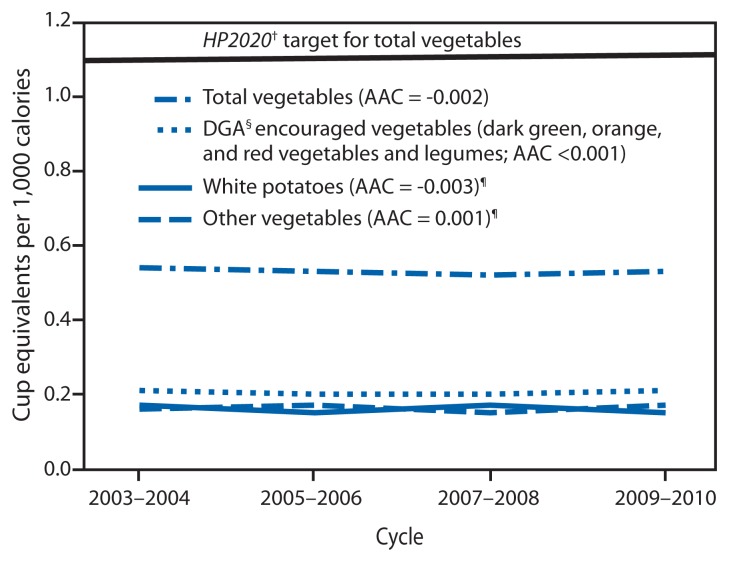
Description:Background ; Eating more fruits and vegetables adds underconsumed nutrients to diets, reduces the risks for leading causes of illness and death, and helps manage body weight. This report describes trends in the contributions of fruits and vegetables to the diets of children aged 2–18 years. ; Methods ; CDC analyzed 1 day of 24-hour dietary recalls from the National Health and Nutrition Examination Surveys from 2003 to 2010 to estimate trends in children’s fruit and vegetable intake in cup-equivalents per 1,000 calories (CEPC) and trends by sex, age, race/ethnicity, family income to poverty ratio, and obesity status. Total fruit includes whole fruit (all fruit excluding juice) and fruit juice (from 100% juice, foods, and other beverages). Total vegetables include those encouraged in the Dietary Guidelines for Americans, 2010 (i.e., dark green, orange, and red vegetables and legumes), white potatoes, and all other vegetables. ; Results ; Total fruit intake among children increased from 0.55 CEPC in 2003–2004 to 0.62 in 2009–2010 because of significant increases in whole fruit intake (0.24 to 0.40 CEPC). Over this period, fruit juice intake significantly decreased (0.31 to 0.22 CEPC). Total vegetable intake did not change (0.54 to 0.53 CEPC). No socio-demographic group met the Healthy People 2020 target of 1.1 CEPC vegetables, and only children aged 2–5 years met the target of 0.9 CEPC fruits. ; Conclusions ; Children’s total fruit intake increased because of increases in whole fruit consumption, but total vegetable intake remained unchanged. ; Implications for Public Health Practice ; Increased attention to the policies and food environments in multiple settings, including schools, early care and education, and homes might help continue the progress in fruit intake and improve vegetable intake.
-
Subjects:
-
Source:MMWR Morbidity Mortal Weekly Rep. 2014; 63(31):671-676.
-
Series:
-
ISSN:0149-2195 (print) ; 1545-861X (digital)
-
Pubmed ID:25102415
-
Pubmed Central ID:PMC4584658
-
Document Type:
-
Corporate as Subject:
-
Place as Subject:
-
Pages in Document:6 pdf pages
-
Volume:63
-
Issue:31
-
Download URL:
-
File Type:
 [PDF - 383.43 KB]
 -
Collection(s):
-
Main Document Checksum:urn:sha-512:1775a79b7815026370feb9cf3be2ac32248b21b1ad3e84d8bbccf59a5636edace8bec0dfca62c017f6ce4da73189a34577a39e8a180022bb5be906660bb624e7
Supporting Files


 Was this page helpful?
 Found an issue?

CDC STACKS serves as an archival repository of CDC-published products including
scientific findings, journal articles, guidelines, recommendations, or other public health information authored or
co-authored by CDC or funded partners.
As a repository, CDC STACKS retains documents in their original published format to ensure public access to scientific information.
As a repository, CDC STACKS retains documents in their original published format to ensure public access to scientific information.
You May Also Like
COLLECTION
Morbidity and Mortality Weekly Report (MMWR)