



Very High Blood Lead Levels Among Adults — United States, 2002–2011
Supporting Files
Public Domain

-
Nov 29 2013
Details
-
Journal Article:Morbidity and Mortality Weekly Report (MMWR)
-
Personal Author:
-
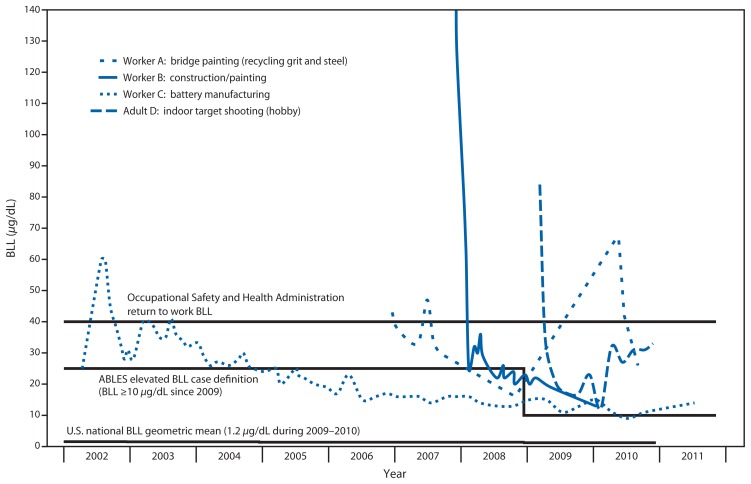
Description:Over the past several decades there has been a remarkable reduction in environmental sources of lead, improved protection from occupational lead exposure, and an overall decreasing trend in the prevalence of elevated blood lead levels (BLLs) in U.S. adults. As a result, the U.S. national BLL geometric mean among adults was 1.2 µg/dL during 2009-2010. Nonetheless, lead exposures continue to occur at unacceptable levels. Current research continues to find that BLLs previously considered harmless can have harmful effects in adults, such as decreased renal function and increased risk for hypertension and essential tremor at BLLs <10 µg/dL. CDC has designated 10 µg/dL as the reference BLL for adults; levels ≥10 µg/dL are considered elevated. CDC's Adult Blood Lead Epidemiology and Surveillance (ABLES) program tracks elevated BLLs among adults in the United States. In contrast to the CDC reference level, prevailing Occupational Safety and Health Administration (OSHA) lead standards allow workers removed from lead exposure to return to lead work when their BLL falls below 40 µg/dL. During 2002-2011, ABLES identified 11,536 adults with very high BLLs (≥40 µg/dL). Persistent very high BLLs (≥40 µg/dL in ≥2 years) were found among 2,210 (19%) of these adults. Occupational exposures accounted for 7,076 adults with very high BLLs (91% of adults with known exposure source) and 1,496 adults with persistent very high BLLs. Adverse health effects associated with very high BLLs underscore the need for increased efforts to prevent lead exposure at workplaces and in communities.
-
Subjects:
-
Source:MMWR Morbidity Mortal Weekly Rep. 2013; 62(47):967-971.
-
Series:
-
ISSN:0149-2195 (print) ; 1545-861X (digital)
-
Pubmed ID:24280917
-
Pubmed Central ID:PMC4585637
-
Document Type:
-
Place as Subject:
-
Pages in Document:5 pdf pages
-
Volume:62
-
Issue:47
-
Download URL:
-
File Type:
 [PDF - 352.03 KB]
 -
Collection(s):
-
Main Document Checksum:urn:sha-512:944e2002db74cf4cbc8e4c44bc16a1034816459d8baf2f1662c410cc6c26de0f442490147fe06d5c8c23cdef5d145158dec80ad4b6fb6f14797867a284990d97
Supporting Files

Related Documents


 Was this page helpful?
 Found an issue?

CDC STACKS serves as an archival repository of CDC-published products including
scientific findings, journal articles, guidelines, recommendations, or other public health information authored or
co-authored by CDC or funded partners.
As a repository, CDC STACKS retains documents in their original published format to ensure public access to scientific information.
As a repository, CDC STACKS retains documents in their original published format to ensure public access to scientific information.
You May Also Like
COLLECTION
Morbidity and Mortality Weekly Report (MMWR)