



Vital Signs: Changes in Opioid Prescribing in the United States, 2006–2015
Supporting Files
Public Domain

-
Jul 07 2017
Details
-
Alternative Title:Changes in Opioid Prescribing in the United States, 2006–2015
-
Journal Article:Morbidity and Mortality Weekly Report (MMWR)
-
Personal Author:
-
Description:Background
Prescription opioid–related overdose deaths increased sharply during 1999–2010 in the United States in parallel with increased opioid prescribing. CDC assessed changes in national-level and county-level opioid prescribing during 2006–2015.
Methods
CDC analyzed retail prescription data from QuintilesIMS to assess opioid prescribing in the United States from 2006 to 2015, including rates, amounts, dosages, and durations prescribed. CDC examined county-level prescribing patterns in 2010 and 2015.
Results
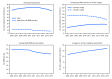
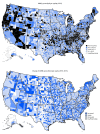
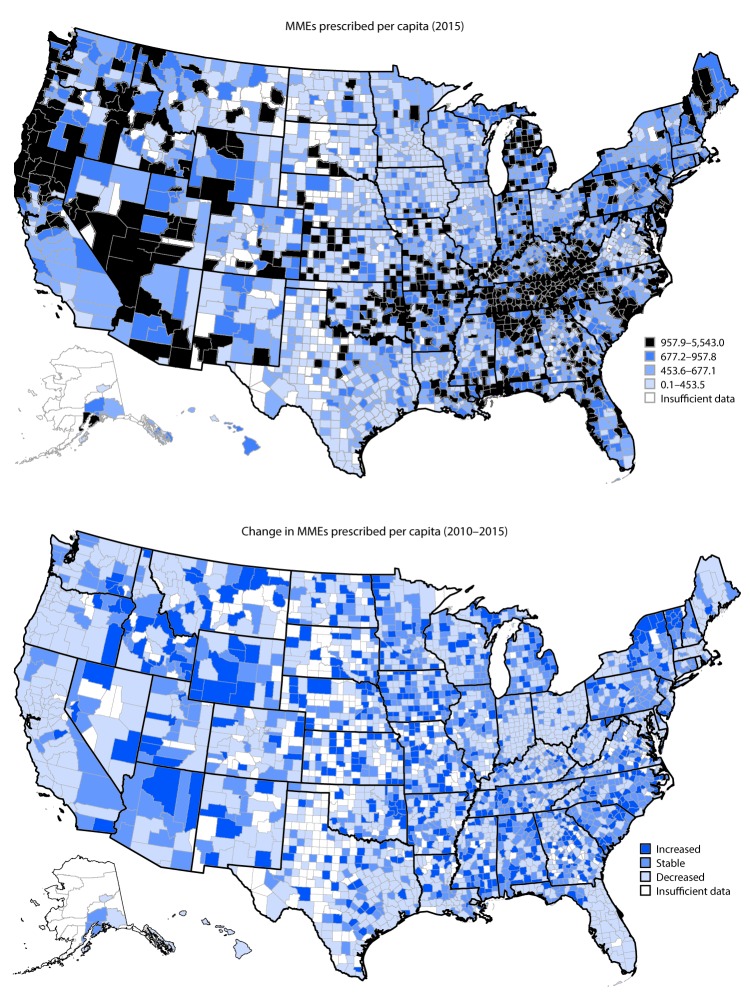
The amount of opioids prescribed in the United States peaked at 782 morphine milligram equivalents (MME) per capita in 2010 and then decreased to 640 MME per capita in 2015. Despite significant decreases, the amount of opioids prescribed in 2015 remained approximately three times as high as in 1999 and varied substantially across the country. County-level factors associated with higher amounts of prescribed opioids include a larger percentage of non-Hispanic whites; a higher prevalence of diabetes and arthritis; micropolitan status (i.e., town/city; nonmetro); and higher unemployment and Medicaid enrollment.
Conclusions and Implications for Public Health Practice
Despite reductions in opioid prescribing in some parts of the country, the amount of opioids prescribed remains high relative to 1999 levels and varies substantially at the county-level. Given associations between opioid prescribing, opioid use disorder, and overdose rates, health care providers should carefully weigh the benefits and risks when prescribing opioids outside of end-of-life care, follow evidence-based guidelines, such as CDC’s Guideline for Prescribing Opioids for Chronic Pain, and consider nonopioid therapy for chronic pain treatment. State and local jurisdictions can use these findings combined with Prescription Drug Monitoring Program data to identify areas with prescribing patterns that place patients at risk for opioid use disorder and overdose and to target interventions with prescribers based on opioid prescribing guidelines. -
Subjects:
-
Source:MMWR Morbidity Mortal Weekly Rep. 66(26):697-704.
-
Series:
-
DOI:
-
ISSN:0149-2195 (print) ; 1545-861X (digital)
-
Pubmed ID:28683056
-
Pubmed Central ID:PMC5726238
-
Document Type:
-
Corporate as Subject:
-
Place as Subject:
-
Pages in Document:8 pdf pages
-
Volume:66
-
Issue:26
-
Download URL:
-
File Type:
 [PDF - 3.64 MB]
 -
Collection(s):
-
Main Document Checksum:urn:sha-512:0810c9b7427499e99929dcf3e97d740d5679714dcb13f5f817bcf71abb71c19e9c6902066dbe05e89b480b994f06365499f48c14ee0515f35e86b7441bc6eba6
Supporting Files


 Was this page helpful?
 Found an issue?


CDC STACKS serves as an archival repository of CDC-published products including
scientific findings, journal articles, guidelines, recommendations, or other public health information authored or
co-authored by CDC or funded partners.
As a repository, CDC STACKS retains documents in their original published format to ensure public access to scientific information.
As a repository, CDC STACKS retains documents in their original published format to ensure public access to scientific information.
You May Also Like
COLLECTION
Morbidity and Mortality Weekly Report (MMWR)