


Dust control by air-blocking shelves and dust collector-to-bailing airflow ratios for a surface mine drill shroud
Supporting Files

-
May 2018
-
File Language:
English
Details
-
Alternative Title:Min Eng
-
Personal Author:
-
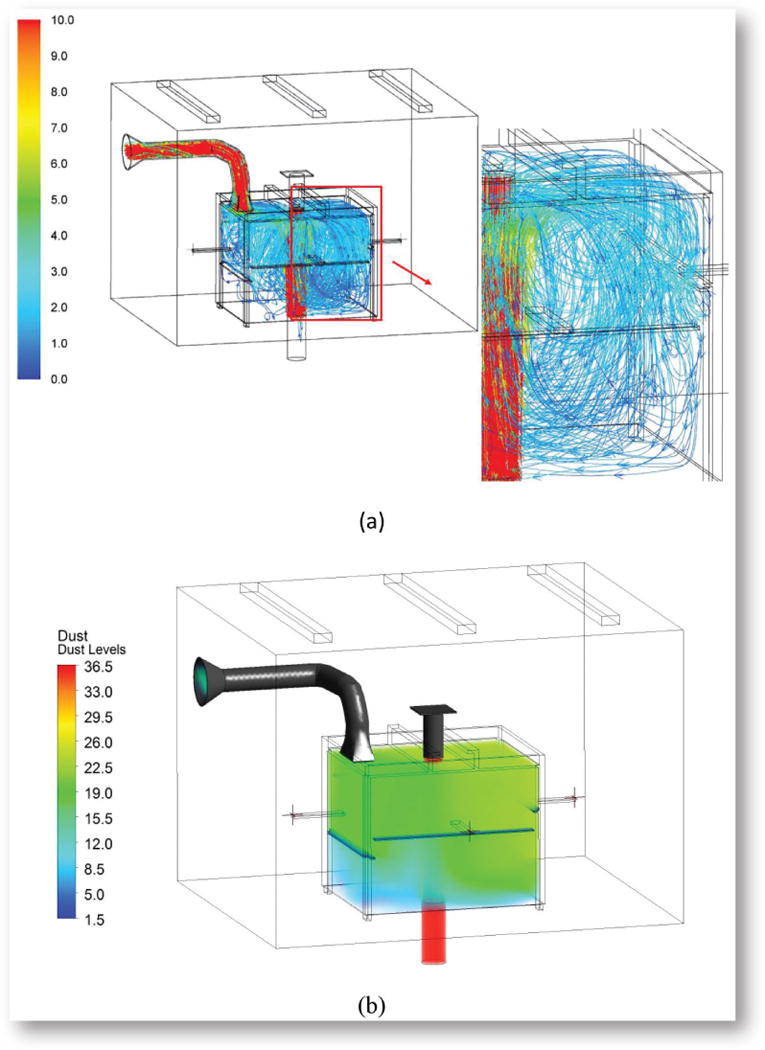
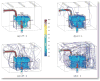
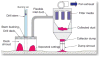
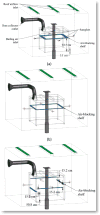
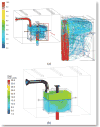
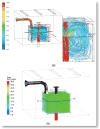
Description:The National Institute for Occupational Safety and Health (NIOSH) recently developed a series of validated models utilizing computational fluid dynamics (CFD) to study the effects of air-blocking shelves on airflows and respirable dust distribution associated with medium-sized surface blasthole drill shrouds as part of a dry dust collector system. Using validated CFD models, three different air-blocking shelves were included in the present study: a 15.2-cm (6-in.)-wide shelf; a 7.6-cm (3-in.)-wide shelf; and a 7.6-cm (3-in.)-wide shelf at four different shelf heights. In addition, the dust-collector-to-bailing airflow ratios of 1.75:1, 1.5:1, 1.25:1 and 1:1 were evaluated for the 15.2-cm (6-in.)-wide air-blocking shelf. This paper describes the methodology used to develop the CFD models. The effects of air-blocking shelves and dust collector-to-bailing airflow ratios were identified by the study, and problem regions were revealed under certain conditions.
-
Subjects:
-
Source:Min Eng. 70(5):69-74.
-
Pubmed ID:29780181
-
Pubmed Central ID:PMC5956536
-
Document Type:
-
Funding:
-
Volume:70
-
Issue:5
-
Collection(s):
-
Main Document Checksum:urn:sha256:cc4a9fda3640a5a248da43620a36dc8c2bd3fc53576363ff30d58fc46d6d1df7
-
Download URL:
-
File Type:
 [PDF
- 1.06 MB
]
[PDF
- 1.06 MB
]
Supporting Files


File Language:
English
ON THIS PAGE







CDC STACKS serves as an archival repository of CDC-published products including
scientific findings,
journal articles, guidelines, recommendations, or other public health information authored or
co-authored by CDC or funded partners.
As a repository, CDC STACKS retains documents in their original published format to ensure public access to scientific information.
As a repository, CDC STACKS retains documents in their original published format to ensure public access to scientific information.
You May Also Like
COLLECTION
CDC Public Access