



Disparities in Hospital-Reported Breast Milk Use in Neonatal Intensive Care Units — United States, 2015
Supporting Files
Public Domain

-
Dec 08 2017
Details
-
Journal Article:Morbidity and Mortality Weekly Report (MMWR)
-
Personal Author:
-
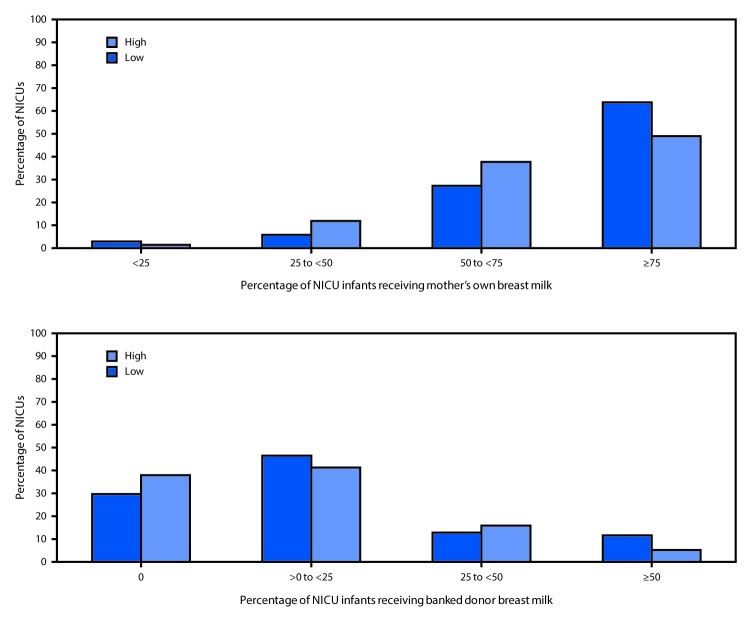
Description:Breast milk is the recommended nutrition for infants. For preterm infants, when mother's milk is not available, pasteurized donor milk is recommended (1). Non-Hispanic black mothers are at increased risk for having a preterm birth and for not breastfeeding (2,3); however, it is not known whether demographic disparities exist in the use of breast milk in neonatal intensive care units (NICUs). Data from CDC's 2015 Maternity Practices in Infant Nutrition and Care (mPINC) survey, which does not collect patient-level demographics, were linked to the 2011-2015 U.S. Census Bureau's American Community Survey (ACS)* to examine use of breast milk in NICUs based on demographic makeup of the hospital's postal code area. Among U.S. hospitals with a NICU, the use of mother's own milk and donor milk were examined by the percentage of non-Hispanic black (black) residents in the hospital postal code area, categorized as being above or below the national average (12.3%). In postal codes with >12.3% black residents, 48.9% of hospitals reported using mothers' own milk in ≥75% of infants in the NICU, and 38.0% reported not using donor milk, compared with 63.8% and 29.6% of hospitals, respectively, in postal codes with ≤12.3% black residents. Further investigation is needed to understand variations in breast milk use in NICUs. Targeted efforts to increase breast milk use in hospitals located in postal codes where the percentage of black mothers is above the national average might help ensure more equitable access to breast milk for preterm and other high-risk infants.
-
Subjects:
-
Source:MMWR Morbidity Mortal Weekly Rep. 66(48):1313-1317.
-
Series:
-
DOI:
-
ISSN:0149-2195 (print) ; 1545-861X (digital)
-
Pubmed ID:29216029
-
Pubmed Central ID:PMC5757635
-
Document Type:
-
Place as Subject:
-
Pages in Document:5 pdf pages
-
Volume:66
-
Issue:48
-
Download URL:
-
File Type:
 [PDF - 156.54 KB]
 -
Collection(s):
-
Main Document Checksum:urn:sha-512:ef298268c7bd2259490050b28f9b485c2bb2c49ea39fcb46701b36e95fc23186310281a54dd885fb3112e898e7779d36a912bcf47cb134737784ba9bcecadc8f
Supporting Files


 Was this page helpful?
 Found an issue?

CDC STACKS serves as an archival repository of CDC-published products including
scientific findings, journal articles, guidelines, recommendations, or other public health information authored or
co-authored by CDC or funded partners.
As a repository, CDC STACKS retains documents in their original published format to ensure public access to scientific information.
As a repository, CDC STACKS retains documents in their original published format to ensure public access to scientific information.
You May Also Like
COLLECTION
Morbidity and Mortality Weekly Report (MMWR)