



Progress Toward Poliomyelitis Eradication — Nigeria, January–December 2017
Supporting Files
Public Domain

-
Mar 02 2018
Details
-
Journal Article:Morbidity and Mortality Weekly Report (MMWR)
-
Personal Author:Bolu, Omotayo ; Nnadi, Chimeremma ; Damisa, Eunice ; Braka, Fiona ; Siddique, Anisur ; Archer, W. Roodly ; Bammeke, Philip ; Banda, Richard ; Higgins, Jeffrey ; Edukugo, Aboyowa ; Nganda, Gatei wa ; Forbi, Joseph C. ; Liu, Hongmei ; Gidado, Saheed ; Soghaier, Mohammed ; Franka, Richard ; Waziri, Ndadilnasiya ; Burns, Cara C. ; Vertefeuille, John ; Wiesen, Eric ; Adamu, Usman
-
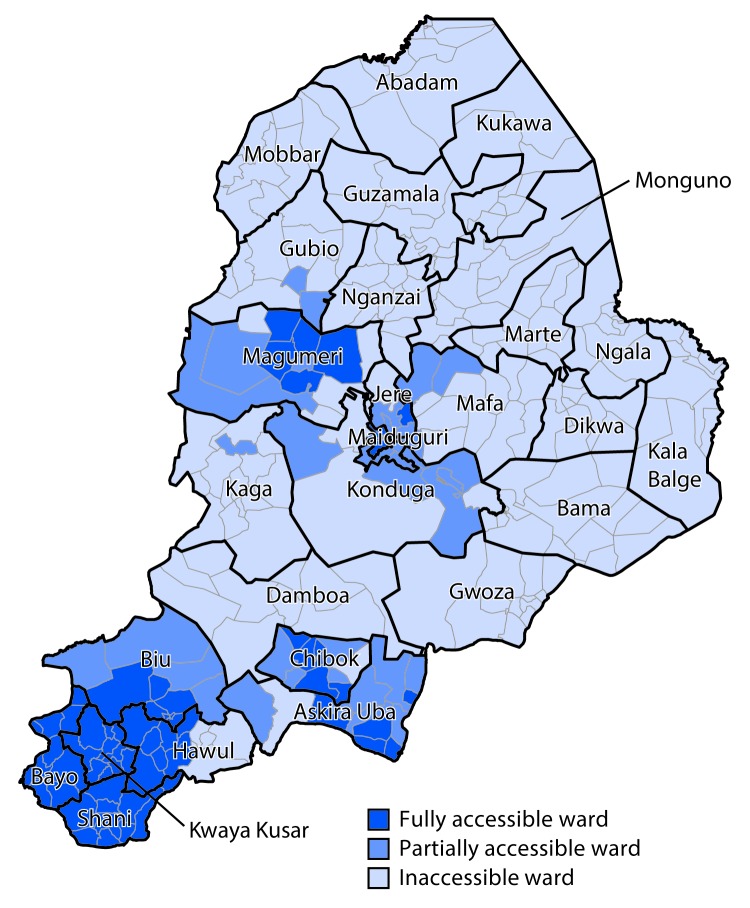
Description:Nearly three decades after the World Health Assembly launched the Global Polio Eradication Initiative in 1988, four of the six World Health Organization (WHO) regions have been certified polio-free (1). Nigeria is one of three countries, including Pakistan and Afghanistan, where wild polioVirus (WPV) Transmission has never been interrupted. In September 2015, after >1 year without any reported WPV cases, Nigeria was removed from WHO's list of countries with endemic WPV Transmission (2); however, during August and September 2016, four type 1 WPV (WPV1) cases were reported from Borno State, a state in northeastern Nigeria experiencing a violent insurgency (3). The Nigerian government, in collaboration with partners, launched a large-scale coordinated response to the outbreak (3). This report describes progress in polio eradication activities in Nigeria during January-December 2017 and updates previous reports (3-5). No WPV cases have been reported in Nigeria since September 2016; the latest case had onset of paralysis on August 21, 2016 (3). However, polio Surveillance has not been feasible in insurgent-controlled areas of Borno State. Implementation of new strategies has helped mitigate the challenges of reaching and vaccinating children living in security-compromised areas, and other strategies are planned. Despite these initiatives, however, approximately 130,000-210,000 (28%-45%) of the estimated 469,000 eligible children living in inaccessible areas in 2016 have not been vaccinated. Sustained efforts to optimize Surveillance and improve immunization coverage, especially among children in inaccessible areas, are needed.
-
Subjects:
-
Source:MMWR Morbidity Mortal Weekly Rep. 67(8):253-256.
-
Series:
-
DOI:
-
ISSN:0149-2195 (print) ; 1545-861X (digital)
-
Pubmed ID:29494568
-
Pubmed Central ID:PMC5861699
-
Document Type:
-
Place as Subject:
-
Pages in Document:4 pdf pages
-
Volume:67
-
Issue:8
-
Download URL:
-
File Type:
 [PDF - 794.53 KB]
 -
Collection(s):
-
Main Document Checksum:urn:sha-512:9f58100d41778adb38836fdbd7e43dcae26aea98c8dd04f6bf808323aaeaa348ff778b1abc983b061a59e694277eac83d82c8507a57b8a3210c895d423d32ef7
Supporting Files


 Was this page helpful?
 Found an issue?



CDC STACKS serves as an archival repository of CDC-published products including
scientific findings, journal articles, guidelines, recommendations, or other public health information authored or
co-authored by CDC or funded partners.
As a repository, CDC STACKS retains documents in their original published format to ensure public access to scientific information.
As a repository, CDC STACKS retains documents in their original published format to ensure public access to scientific information.
You May Also Like
COLLECTION
Morbidity and Mortality Weekly Report (MMWR)