



Progress Toward Measles Elimination — Bangladesh, 2000–2016
Supporting Files
Public Domain

-
Jul 21 2017
Details
-
Journal Article:Morbidity and Mortality Weekly Report (MMWR)
-
Personal Author:
-
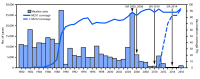
Description:In 2013, at the 66th session of the Regional Committee of the World Health Organization (WHO) South-East Asia Region (SEAR), a regional goal was established to eliminate measles and control rubella and Congenital rubella syndrome* by 2020 (1). WHO-recommended measles elimination strategies in SEAR countries include 1) achieving and maintaining ≥95% coverage with 2 doses of measles-containing vaccine (MCV) in every district, delivered through the routine immunization program or through supplementary immunization activities (SIAs)|; 2) developing and sustaining a sensitive and timely measles case-based Surveillance system that meets targets for recommended performance indicators; and 3) developing and maintaining an accredited measles laboratory network (2). In 2014, Bangladesh, one of 11 countries in SEAR, adopted a national goal for measles elimination by 2018 (2,3). This report describes progress and challenges toward measles elimination in Bangladesh during 2000-2016. Estimated coverage with the first MCV dose (MCV1) increased from 74% in 2000 to 94% in 2016. The second MCV dose (MCV2) was introduced in 2012, and MCV2 coverage increased from 35% in 2013 to 93% in 2016. During 2000-2016, approximately 108.9 million children received MCV during three nationwide SIAs conducted in phases. During 2000-2016, reported confirmed measles incidence decreased 82%, from 34.2 to 6.1 per million population. However, in 2016, 56% of districts did not meet the Surveillance performance target of ≥2 discarded nonmeasles, nonrubella cases| per 100,000 population. Additional measures that include increasing MCV1 and MCV2 coverage to ≥95% in all districts with additional strategies for hard-to-reach populations, increasing sensitivity of measles case-based Surveillance, and ensuring timely transport of specimens to the national laboratory will help achieve measles elimination.
-
Subjects:
-
Source:MMWR Morbidity Mortal Weekly Rep. 66(28):753-757.
-
Series:
-
DOI:
-
ISSN:0149-2195 (print) ; 1545-861X (digital)
-
Pubmed ID:28727678
-
Pubmed Central ID:PMC5657944
-
Document Type:
-
Place as Subject:
-
Pages in Document:5 pdf pages
-
Volume:66
-
Issue:28
-
Download URL:
-
File Type:
 [PDF - 331.02 KB]
 -
Collection(s):
-
Main Document Checksum:urn:sha-512:b9f56f4b5f0ec68c0f7f6ea08f5db877d4388f657fed1ca55f2a156d09c7f17f49c2760bb201837585c81071ac5fa3414fee92c0410a7e8ac3a41d1426b3be1e
Supporting Files


 Was this page helpful?
 Found an issue?


CDC STACKS serves as an archival repository of CDC-published products including
scientific findings, journal articles, guidelines, recommendations, or other public health information authored or
co-authored by CDC or funded partners.
As a repository, CDC STACKS retains documents in their original published format to ensure public access to scientific information.
As a repository, CDC STACKS retains documents in their original published format to ensure public access to scientific information.
You May Also Like
COLLECTION
Morbidity and Mortality Weekly Report (MMWR)