



Introduction of Inactivated Poliovirus Vaccine and Switch from Trivalent to Bivalent Oral Poliovirus Vaccine — Worldwide, 2013–2016
Supporting Files
Public Domain

-
Jul 03 2015
Details
-
Journal Article:Morbidity and Mortality Weekly Report (MMWR)
-
Corporate Authors:
-
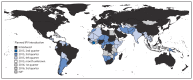
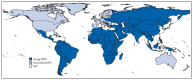
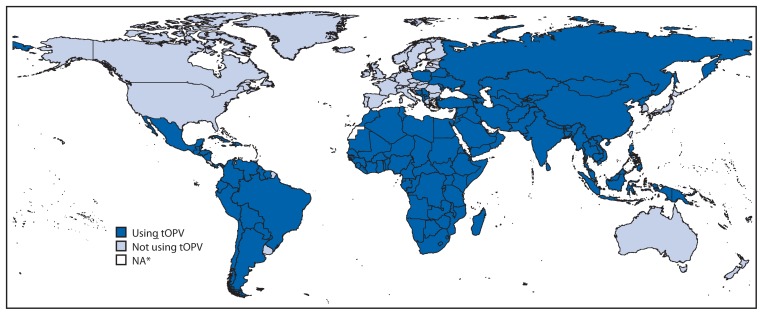
Description:Since the 1988 World Health Assembly resolution to eradicate poliomyelitis (polio), transmission of wild poliovirus (WPV) has been interrupted in all countries except Afghanistan, Nigeria, and Pakistan. No polio cases caused by WPV type 2 (WPV2) have been identified since 1999, and WPV type 3 has not been detected since November 11, 2012. This progress has been achieved through widespread use of oral poliovirus vaccine (OPV), most commonly trivalent OPV (tOPV), which contains types 1, 2, and 3 live, attenuated polioviruses. OPV polioviruses can undergo genetic changes during intestinal replication, and rarely, in communities with low vaccination coverage, such changes can result in vaccine-derived polioviruses (VDPVs) capable of causing paralytic polio. Eliminating the risk for polio caused by VDPVs will require stopping all OPV use. Among 686 cases of paralytic polio caused by circulating VDPVs (cVDPVs) that have been detected since 2006, type 2 cVDPVs (cVDPV2s) accounted for >97%. To eliminate the risks posed by cVDPV2s, OPV serotype 2 will be withdrawn from all immunization activities and programs through a global, synchronized replacement of all tOPV with bivalent OPV (bOPV) containing only types 1 and 3 polioviruses. This switch from tOPV to bOPV is scheduled for April 2016. To reduce the risk for cVDPV2 outbreaks and to facilitate responses to outbreaks that do occur, injectable trivalent inactivated poliovirus vaccine (IPV) is being introduced into routine immunization schedules in all countries. As of June 24, 2015, 90 (46%) of 194 World Health Organization (WHO) member states were using IPV, 102 (53%) had established dates for the introduction of IPV, and two (1%) intended to introduce IPV in 2015 but had not set dates for doing so. In addition to IPV introduction in all countries, careful synchronization of the switch from tOPV to bOPV will be needed within and across all 156 countries currently using tOPV. This report summarizes progress in introducing IPV and preparations for the switch from tOPV to bOPV.
-
Subjects:
-
Source:MMWR Morbidity Mortal Weekly Rep. 2015; 64(25):699-702.
-
Series:
-
ISSN:0149-2195 (print) ; 1545-861X (digital)
-
Pubmed ID:26135591
-
Pubmed Central ID:PMC4584682
-
Document Type:
-
Pages in Document:4 pdf pages
-
Volume:64
-
Issue:25
-
Download URL:
-
File Type:
 [PDF - 1.90 MB]
 -
Collection(s):
-
Main Document Checksum:urn:sha-512:cad834ebf0e411a8f6decd62197f18b031f99fdba3bd36c57b64df414dd26267f6c05e6ed5473deb32b1ad5be5051f214a6e7ff1c23bf46de849cadd58fc1467
Supporting Files


 Was this page helpful?
 Found an issue?


CDC STACKS serves as an archival repository of CDC-published products including
scientific findings, journal articles, guidelines, recommendations, or other public health information authored or
co-authored by CDC or funded partners.
As a repository, CDC STACKS retains documents in their original published format to ensure public access to scientific information.
As a repository, CDC STACKS retains documents in their original published format to ensure public access to scientific information.
You May Also Like
COLLECTION
Morbidity and Mortality Weekly Report (MMWR)