



Clinical Inquiries Regarding Ebola Virus Disease Received by CDC — United States, July 9–November 15, 2014
Supporting Files
Public Domain

-
Dec 12 2014
Details
-
Journal Article:Morbidity and Mortality Weekly Report (MMWR)
-
Personal Author:Karwowski, Mateusz P. ; Meites, Elissa ; Fullerton, Kathleen E. ; Ströher, Ute ; Lowe, Luis ; Rayfield, Mark ; Blau, Dianna M. ; Knust, Barbara ; Gindler, Jacqueline ; Van Beneden, Chris ; Bialek, Stephanie R. ; Mead, Paul ; Oster, Alexandra M.
-
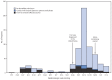
Description:Since early 2014, there have been more than 6,000 reported deaths from Ebola Virus disease (Ebola), mostly in Guinea, Liberia, and Sierra Leone. On July 9, 2014, CDC activated its Emergency Operations Center for the Ebola outbreak response and formalized the consultation service it had been providing to assist state and local public health officials and health care providers evaluate persons in the United States thought to be at risk for Ebola. During July 9-November 15, CDC responded to clinical inquiries from public health officials and health care providers from 49 states and the District of Columbia regarding 650 persons thought to be at risk. Among these, 118 (18%) had initial signs or symptoms consistent with Ebola and epidemiologic risk factors placing them at risk for infection, thereby meeting the definition of persons under investigation (PUIs). Testing was not always performed for PUIs because alternative diagnoses were made or symptoms resolved. In total, 61 (9%) persons were tested for Ebola Virus, and four, all of whom met PUI criteria, had laboratory-confirmed Ebola. Overall, 490 (75%) inquiries concerned persons who had neither traveled to an Ebola-affected country nor had contact with an Ebola patient. Appropriate medical evaluation and treatment for other conditions were noted in some instances to have been delayed while a person was undergoing evaluation for Ebola. Evaluating and managing persons who might have Ebola is one component of the overall approach to domestic Surveillance, the goal of which is to rapidly identify and isolate Ebola patients so that they receive appropriate medical care and secondary Transmission is prevented. Health care providers should remain vigilant and consult their local and state health departments and CDC when assessing ill travelers from Ebola-affected countries. Most of these persons do not have Ebola; prompt diagnostic assessments, laboratory tTesting, and provision of appropriate care for other conditions are essential for appropriate patient care and reflect hospital preparedness.
-
Subjects:
-
Source:MMWR Morbidity Mortal Weekly Rep. 2014; 63(49):1175-1179.
-
Series:
-
ISSN:0149-2195 (print) ; 1545-861X (digital)
-
Pubmed ID:25503923
-
Pubmed Central ID:PMC4584543
-
Document Type:
-
Place as Subject:
-
Pages in Document:5 pdf pages
-
Volume:63
-
Issue:49
-
Download URL:
-
File Type:
 [PDF - 366.27 KB]
 -
Collection(s):
-
Main Document Checksum:urn:sha-512:a834fe4324be916ff46a92973f4170b6b0ccfcda80d0d9885326aeb0a51bb489126ef2cec4c3871231ec76fa9a4ec0baa6d3e548fa29119cbe09bf76f46d7d13
Supporting Files


 Was this page helpful?
 Found an issue?



CDC STACKS serves as an archival repository of CDC-published products including
scientific findings, journal articles, guidelines, recommendations, or other public health information authored or
co-authored by CDC or funded partners.
As a repository, CDC STACKS retains documents in their original published format to ensure public access to scientific information.
As a repository, CDC STACKS retains documents in their original published format to ensure public access to scientific information.
You May Also Like
COLLECTION
Morbidity and Mortality Weekly Report (MMWR)