


Developing measures to assess constructs from the Inner Setting domain of the Consolidated Framework for Implementation Research
Supporting Files

-
Mar 27 2018
-
File Language:
English
Details
-
Alternative Title:Implement Sci
-
Personal Author:
-
Description:Background
Scientists and practitioners alike need reliable, valid measures of contextual factors that influence implementation. Yet, few existing measures demonstrate reliability or validity. To meet this need, we developed and assessed the psychometric properties of measures of several constructs within the Inner Setting domain of the Consolidated Framework for Implementation Research (CFIR).
Methods
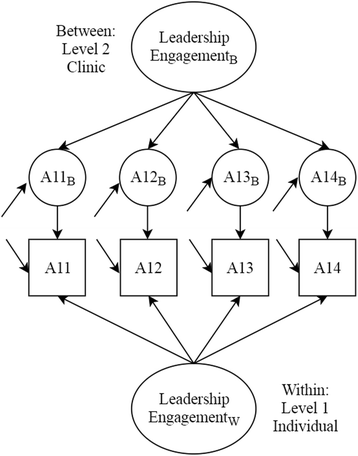
We searched the literature for existing measures for the 7 Inner Setting domain constructs (Culture Overall, Culture Stress, Culture Effort, Implementation Climate, Learning Climate, Leadership Engagement, and Available Resources). We adapted items for the healthcare context, pilot-tested the adapted measures in 4 Federally Qualified Health Centers (FQHCs), and implemented the revised measures in 78 FQHCs in the 7 states (N = 327 respondents) with a focus on colorectal cancer (CRC) screening practices. To psychometrically assess our measures, we conducted confirmatory factor analysis models (CFA; structural validity), assessed inter-item consistency (reliability), computed scale correlations (discriminant validity), and calculated inter-rater reliability and agreement (organization-level construct reliability and validity).
Results
CFAs for most constructs exhibited good model fit (CFI > 0.90, TLI > 0.90, SRMR < 0.08, RMSEA < 0.08), with almost all factor loadings exceeding 0.40. Scale reliabilities ranged from good (0.7 ≤ α < 0.9) to excellent (α ≥ 0.9). Scale correlations fell below 0.90, indicating discriminant validity. Inter-rater reliability and agreement were sufficiently high to justify measuring constructs at the clinic-level.
Conclusions
Our findings provide psychometric evidence in support of the CFIR Inner Setting measures. Our findings also suggest the Inner Setting measures from individuals can be aggregated to represent the clinic-level. Measurement of the Inner Setting constructs can be useful in better understanding and predicting implementation in FQHCs and can be used to identify targets of strategies to accelerate and enhance implementation efforts in FQHCs.
-
Subjects:
-
Source:Implement Sci. 13.
-
Pubmed ID:29587804
-
Pubmed Central ID:PMC5870186
-
Document Type:
-
Funding:U48DP001911/Centers for Disease Control and Prevention/ ; U48 DP001938/DP/NCCDPHP CDC HHS/United States ; R21 CA136460/CA/NCI NIH HHS/United States ; R01 CA124397/CA/NCI NIH HHS/United States ; U48 DP001911/DP/NCCDPHP CDC HHS/United States ; U48DP0010909/Centers for Disease Control and Prevention/ ; U48 DP001936/DP/NCCDPHP CDC HHS/United States ; U48DP001946/Centers for Disease Control and Prevention/ ; R01CA124397/National Cancer Institute/ ; U48 DP001903/DP/NCCDPHP CDC HHS/United States ; U48DP001934/Centers for Disease Control and Prevention/ ; U48DP001938/Centers for Disease Control and Prevention/ ; R25CA116339/National Cancer Institute/ ; U48 DP001946/DP/NCCDPHP CDC HHS/United States ; U48DP001936/Centers for Disease Control and Prevention/ ; U48 DP001924/DP/NCCDPHP CDC HHS/United States ; R25 CA057712/CA/NCI NIH HHS/United States ; R25 CA116339/CA/NCI NIH HHS/United States ; U48DP001924/Centers for Disease Control and Prevention/ ; U48DP001949/Centers for Disease Control and Prevention/ ; U48DP001903/Centers for Disease Control and Prevention/ ; R21CA136460/National Cancer Institute/ ; U48DP001944/Centers for Disease Control and Prevention/ ; R25CA057712/National Cancer Institute/ ; U48 DP001949/DP/NCCDPHP CDC HHS/United States ; U48 DP001934/DP/NCCDPHP CDC HHS/United States
-
Volume:13
-
Collection(s):
-
Main Document Checksum:urn:sha256:4be6eb3eaffce46c869fd0142d16faf1d0f3d52c268a5ffe90e5181bca1f84ef
-
Download URL:
-
File Type:
 [PDF
- 532.36 KB
]
[PDF
- 532.36 KB
]
Supporting Files


File Language:
English
ON THIS PAGE


CDC STACKS serves as an archival repository of CDC-published products including
scientific findings,
journal articles, guidelines, recommendations, or other public health information authored or
co-authored by CDC or funded partners.
As a repository, CDC STACKS retains documents in their original published format to ensure public access to scientific information.
As a repository, CDC STACKS retains documents in their original published format to ensure public access to scientific information.
You May Also Like
COLLECTION
CDC Public Access