


Twenty-four-hour work shifts, increased job demands, and elevated blood pressure in professional firefighters
Supporting Files

-
Jul 01 2016
File Language:
English
Details
-
Alternative Title:Int Arch Occup Environ Health
-
Personal Author:
-
Description:Purpose
To investigate whether working conditions (number of 24-h shifts, number of calls, sedentary work, job strain, effort–reward imbalance, and physical demands) are associated with elevated blood pressure and hypertension among professional firefighters.
Methods
A total of 330 (321 males and 9 females) firefighters were chosen for this study among the Southern California firefighters who participated in a work and obesity project. Working conditions were measured with a firefighter-specific occupational health questionnaire. Blood pressure was clinically assessed, and hypertension was defined according to the contemporary standard classification.
Results
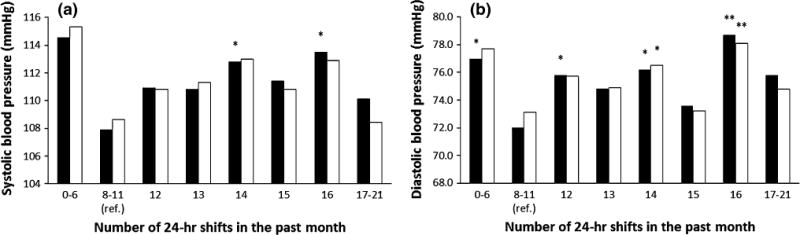
About 11 % of the firefighters had hypertension. Fifty percent of the hypertensive firefighters (mostly mild hypertensive) had uncontrolled high blood pressure. Hypertension was more prevalent in male, older, and high-rank firefighters and firefighter who reported low numbers of daily calls. In male firefighters who were normotensive or hypertensive without taking anti-hypertensive medication, additional 24-h shifts in the past month increased the risk of elevated diastolic blood pressure (DBP) than those who reported a standard work schedule (eight to eleven 24-h shifts). Particularly, firefighters who reported sixteen 24-h shifts had 5.0 mmHg higher DBP (p < 0.01). Body mass index attenuated the association between number of shifts and blood pressure to some extent. Firefighters who reported “increased job demands over the past years” had 3.0 mmHg (p = 0.06) higher systolic blood pressure. Other working conditions were not associated with elevated blood pressure and hypertension.
Conclusions
Many additional 24-h shifts and increased job demands were risk factors for elevated blood pressure in male firefighters. Optimal collective and individual workload and improved hypertension management are warranted for enhancing the cardiovascular health of firefighters.
-
Subjects:
-
Source:Int Arch Occup Environ Health. 89(7):1111-1125.
-
Pubmed ID:27368424
-
Pubmed Central ID:PMC5922442
-
Document Type:
-
Funding:
-
Volume:89
-
Issue:7
-
Collection(s):
-
Main Document Checksum:urn:sha256:1f68b435088740eac659255d7de10e3a330ef5dc520a9ed43ea24c64f3c1521a
-
Download URL:
-
File Type:
 [PDF
- 163.87 KB
]
[PDF
- 163.87 KB
]
Supporting Files


File Language:
English
ON THIS PAGE


CDC STACKS serves as an archival repository of CDC-published products including
scientific findings,
journal articles, guidelines, recommendations, or other public health information authored or
co-authored by CDC or funded partners.
As a repository, CDC STACKS retains documents in their original published format to ensure public access to scientific information.
As a repository, CDC STACKS retains documents in their original published format to ensure public access to scientific information.
You May Also Like
COLLECTION
CDC Public Access