



Epileptiform activity in traumatic brain injury predicts post-traumatic epilepsy
Supporting Files

-
April 10 2018 ; 4-2018
-
Available in CDC Stacks on 2019-04-10T00:00:00Z
File Language:
English
Details
-
Alternative Title:Ann Neurol
-
Personal Author:
-
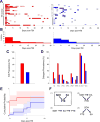
Description:We hypothesize that epileptiform abnormalities (EAs) in the electroencephalogram (EEG) during the acute period following traumatic brain injury (TBI) independently predict first-year post-traumatic epilepsy (PTE| ). We analyze PTE| risk factors in two cohorts matched for TBI severity and age (n = 50). EAs independently predict risk for PTE| (odds ratio OR, 3.16 0.99, 11.68); subdural hematoma is another independent risk factor (OR, 4.13 1.18, 39.33). Differences in EA rates are apparent within 5 days following TBI. Our results suggest that increased EA prevalence identifies patients at increased risk for PTE| , and that EAs acutely post-TBI can identify patients most likely to benefit from antiepileptogenesis drug trials. Ann Neurol 2018;83:858-862.
-
Subjects:
-
Source:Ann Neurol. 83(4):858-862
-
Pubmed ID:29537656
-
Pubmed Central ID:PMC5912971
-
Document Type:
-
Funding:
-
Volume:83
-
Issue:4
-
Download URL:
-
File Type:
 [PDF - 161.70 KB]
 -
Collection(s):
-
Main Document Checksum:urn:sha256:4cd9d9717808d1e086da8ac80060c25bf24dc64adf1207261462fd65b318b04f
Supporting Files


File Language:
English
 Was this page helpful?
 Found an issue?

CDC STACKS serves as an archival repository of CDC-published products including
scientific findings, journal articles, guidelines, recommendations, or other public health information authored or
co-authored by CDC or funded partners.
As a repository, CDC STACKS retains documents in their original published format to ensure public access to scientific information.
As a repository, CDC STACKS retains documents in their original published format to ensure public access to scientific information.
You May Also Like
COLLECTION
CDC Public Access