


Evaluation of Immune Responses in Dogs to Oral Rabies Vaccine under Field Conditions*
Supporting Files

-
October 17 2017
-
File Language:
English
Details
-
Alternative Title:Vaccine
-
Personal Author:
-
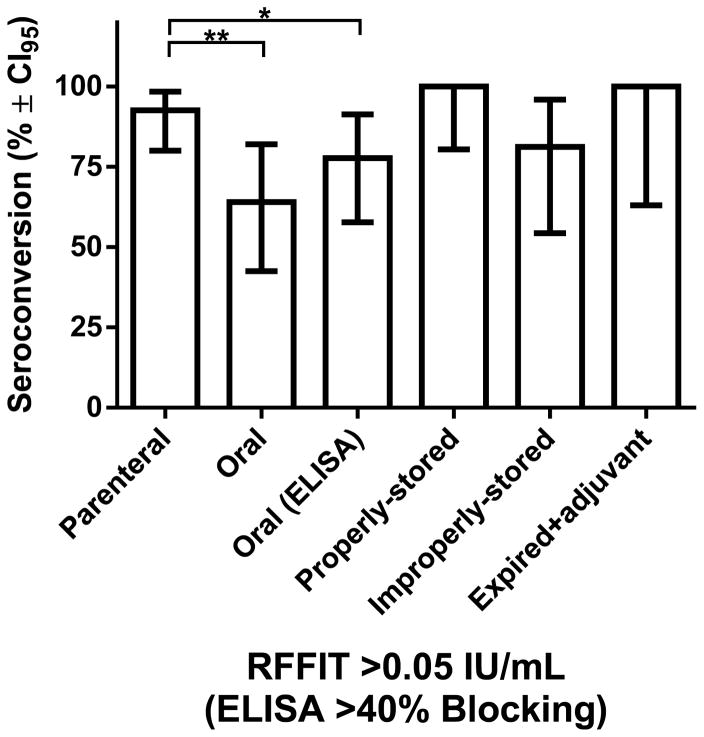
Description:During the 20th century parenteral vaccination of dogs at central-point locations was the foundation of successful canine rabies elimination programs in numerous countries. However, countries that remain enzootic for canine rabies have lower infrastructural development compared to countries that have achieved elimination, which may make traditional vaccination methods less successful. Alternative vaccination methods for dogs must be considered, such as oral rabies vaccine (ORV). In 2016, a traditional mass dog vaccination campaign in Haiti was supplemented with ORV to improve vaccination coverage and to evaluate the use of ORV in dogs. Blisters containing live-attenuated, vaccine strain SPBNGAS-GAS were placed in intestine bait and distributed to dogs by hand. Serum was collected from 107 dogs, aged 3-12 months with no reported prior rabies vaccination, pre-vaccination and from 78/107 dogs (72.9%) 17 days post-vaccination. The rapid florescent focus inhibition test (RFFIT) was used to detect neutralizing antibodies and an ELISA to detect rabies binding antibodies. Post-vaccination, 38/41 (92.7%) dogs that received parenteral vaccine had detectable antibody (RFFIT >0.05 IU/mL), compared to 16/27 (59.3%, p < 0.01) dogs that received ORV or 21/27 (77.8%) as measured by ELISA (>40% blocking, p < 0.05). The fate of 291 oral vaccines was recorded; 283 dogs (97.2%) consumed the bait; 272 dogs (93.4%) were observed to puncture the blister, and only 14 blisters (4.8%) could not be retrieved by vaccinators and were potentially left in the environment. Pre-vaccination antibodies (RFFIT >0.05 IU/mL) were detected in 10/107 reportedly vaccine-naïve dogs (9.3%). Parenteral vaccination remains the most reliable method for ensuring adequate immune response in dogs, however ORV represents a viable strategy to supplement existing parental vaccination campaigns in hard-to-reach dog populations. The hand-out model reduces the risk of unintended contact with ORV through minimizing vaccine blisters left in the community.
-
Subjects:
-
Source:Vaccine. 37(33):4743-4749
-
Pubmed ID:29054727
-
Pubmed Central ID:PMC5904025
-
Document Type:
-
Funding:
-
Volume:37
-
Issue:33
-
Collection(s):
-
Main Document Checksum:urn:sha256:32a769504e73bee3e06ea29ded355f12dab98d1291cd2fe25299462bf0b15bf5
-
Download URL:
-
File Type:
 [PDF
- 230.21 KB
]
[PDF
- 230.21 KB
]
Supporting Files


File Language:
English
ON THIS PAGE

CDC STACKS serves as an archival repository of CDC-published products including
scientific findings,
journal articles, guidelines, recommendations, or other public health information authored or
co-authored by CDC or funded partners.
As a repository, CDC STACKS retains documents in their original published format to ensure public access to scientific information.
As a repository, CDC STACKS retains documents in their original published format to ensure public access to scientific information.
You May Also Like
COLLECTION
CDC Public Access