


House screening with insecticide-treated netting provides sustained reductions in domestic populations of Aedes aegypti in Merida, Mexico
Supporting Files
Public Domain

-
Mar 15 2018
-
File Language:
English
Details
-
Alternative Title:PLoS Negl Trop Dis
-
Personal Author:Che-Mendoza, Azael ; Medina-Barreiro, Anuar ; Koyoc-Cardeña, Edgar ; Uc-Puc, Valentín ; Contreras-Perera, Yamili ; Herrera-Bojórquez, Josué ; Dzul-Manzanilla, Felipe ; Correa-Morales, Fabian ; Ranson, Hilary ; Lenhart, Audrey ; McCall, Philip J. ; Kroeger, Axel ; Vazquez-Prokopec, Gonzalo ; Manrique-Saide, Pablo
-
Description:Background
There is a need for effective methods to control Aedes aegypti and prevent the transmission of dengue, chikungunya, yellow fever and Zika viruses. Insecticide treated screening (ITS) is a promising approach, particularly as it targets adult mosquitoes to reduce human-mosquito contact.
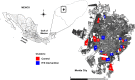
Methodology/Principal findings
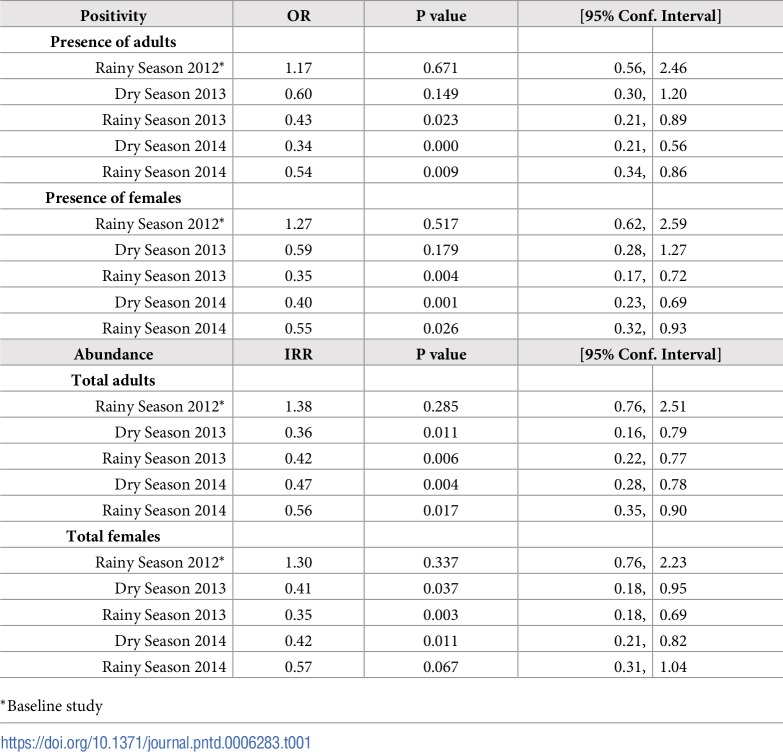
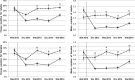
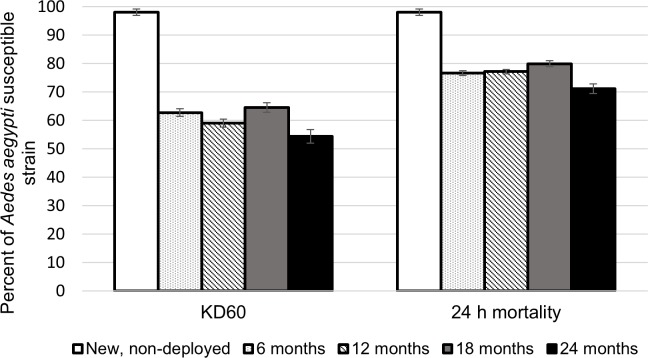
A cluster-randomised controlled trial evaluated the entomological efficacy of ITS based intervention, which consisted of the installation of pyrethroid-impregnated long-lasting insecticide-treated netting material fixed as framed screens on external doors and windows. A total of 10 treatment and 10 control clusters (100 houses/cluster) were distributed throughout the city of Merida, Mexico. Cross-sectional entomological surveys quantified indoor adult mosquito infestation at baseline (pre-intervention) and throughout four post-intervention (PI) surveys spaced at 6-month intervals corresponding to dry/rainy seasons over two years (2012–2014). A total of 844 households from intervention clusters (86% coverage) were protected with ITS at the start of the trial. Significant reductions in the indoor presence and abundance of Ae. aegypti adults (OR = 0.48 and IRR = 0.45, P<0.05 respectively) and the indoor presence and abundance of Ae. aegypti female mosquitoes (OR = 0.47 and IRR = 0.44, P<0.05 respectively) were detected in intervention clusters compared to controls. This high level of protective effect was sustained for up to 24 months PI. Insecticidal activity of the ITS material declined with time, with ~70% mortality being demonstrated in susceptible mosquito cohorts up to 24 months after installation.
Conclusions/Significance
The strong and sustained entomological impact observed in this study demonstrates the potential of house screening as a feasible, alternative approach to a sustained long-term impact on household infestations of Ae. aegypti. Larger trials quantifying the effectiveness of ITS on epidemiological endpoints are warranted and therefore recommended.
-
Subjects:
-
Source:PLoS Negl Trop Dis. 12(3).
-
Pubmed ID:29543805
-
Pubmed Central ID:PMC5870999
-
Document Type:
-
Place as Subject:
-
Volume:12
-
Issue:3
-
Collection(s):
-
Main Document Checksum:urn:sha256:409fa64226059ae53862d27ee388e7ed259b7d2353a1e864203dbc56d32bbec3
-
Download URL:
-
File Type:
 [PDF
- 7.85 MB
]
[PDF
- 7.85 MB
]
Supporting Files


File Language:
English
ON THIS PAGE







CDC STACKS serves as an archival repository of CDC-published products including
scientific findings,
journal articles, guidelines, recommendations, or other public health information authored or
co-authored by CDC or funded partners.
As a repository, CDC STACKS retains documents in their original published format to ensure public access to scientific information.
As a repository, CDC STACKS retains documents in their original published format to ensure public access to scientific information.
You May Also Like
COLLECTION
CDC Public Access