



Dog Bites an Opportunity for Parent Education in the Pediatric Emergency Department
Supporting Files

-
Oct 2012
-
Available in CDC Stacks on 2013-10-01T00:00:00Z
File Language:
English
Details
-
Alternative Title:Pediatr Emerg Care
-
Personal Author:
-
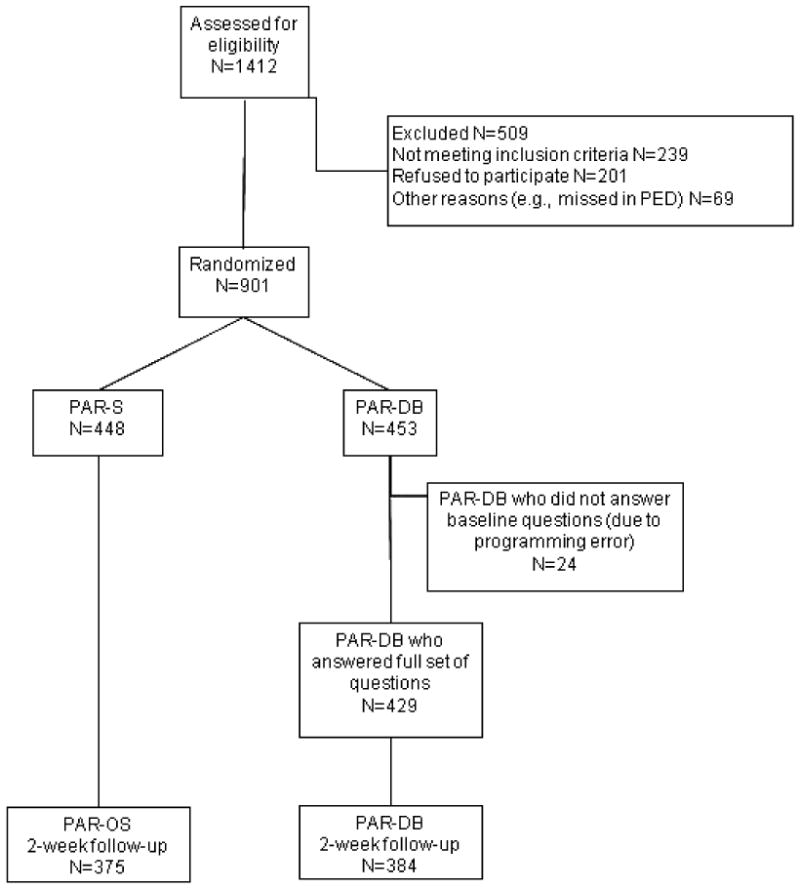
Description:Objectives ; This study focuses on parental report of exposure to dogs and highlights the potential for using a computer kiosk to increase knowledge around dog bite safety in an urban pediatric emergency department. ; Methods ; 901 parents of young children completed a kiosk assessment and received a report which contained information aimed at increasing knowledge about either dog bite prevention (PAR-DB n=453) or other safety behaviors (PAR-S n=448). The participants who received the dog bite prevention report (PAR-DB) were asked questions about exposure to dogs as part of the baseline assessment. All participants were telephoned 2-4 weeks later for a follow-up interview to measure knowledge differences. ; Results ; The majority of respondents who answered the exposure questions reported seeing stray dogs (53%) and having dangerous dogs (43%) in their neighborhood. Few respondents reported that their child had been bitten by a dog (1%), but the majority (56%) reported having knowledge of another child having been bitten. Few respondents reported having a dog in their home (11%) and only one reported that her dog had bitten a child. A majority (56%) of dogs had not been spayed or neutered. Of families with dogs in the home, 20% reported leaving their child unattended with the dog. A minority (45%) of dogs left alone with children had been spayed or neutered. PAR-DB parents achieved knowledge gains as a result of the parent action report generated by the kiosk, demonstrating the potential to improve knowledge via a computer kiosk in a busy pediatric emergency department.
-
Subjects:
-
Source:Pediatr Emerg Care. 28(10):966-970.
-
Pubmed ID:23023457
-
Pubmed Central ID:PMC3674576
-
Document Type:
-
Funding:
-
Place as Subject:
-
Volume:28
-
Issue:10
-
Download URL:
-
File Type:
 [PDF - 58.93 KB]
 -
Collection(s):
-
Main Document Checksum:urn:sha256:0ad8a8dfe7e9dde00cec34d9f690f25340dbd8408a3bb355bee7727cd104fb52
Supporting Files


File Language:
English
 Was this page helpful?
 Found an issue?

CDC STACKS serves as an archival repository of CDC-published products including
scientific findings, journal articles, guidelines, recommendations, or other public health information authored or
co-authored by CDC or funded partners.
As a repository, CDC STACKS retains documents in their original published format to ensure public access to scientific information.
As a repository, CDC STACKS retains documents in their original published format to ensure public access to scientific information.
You May Also Like
COLLECTION
CDC Public Access