



Development of the SaFETy Score: A Clinical Screening Tool for Predicting Future Firearm Violence Risk
Supporting Files

-
Apr 11 2017
-
Available in CDC Stacks on March 30, 2018, 12:00 AM
File Language:
English
Details
-
Alternative Title:Ann Intern Med
-
Personal Author:
-
Description:Background
Interpersonal firearm violence among youth is a substantial public health problem, and emergency department (ED) physicians require a clinical screening tool to identify high-risk youth.
Objective
To derive a clinically feasible risk index for firearm violence.
Design
24-month prospective cohort study.
Setting
Urban, level 1 ED.
Participants
Substance-using youths, aged 14 to 24 years, seeking ED care for an assault-related injury and a proportionately sampled group of non–assault-injured youth enrolled from September 2009 through December 2011.
Measurements
Firearm violence (victimization/perpetration) and validated questionnaire items.
Results
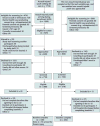
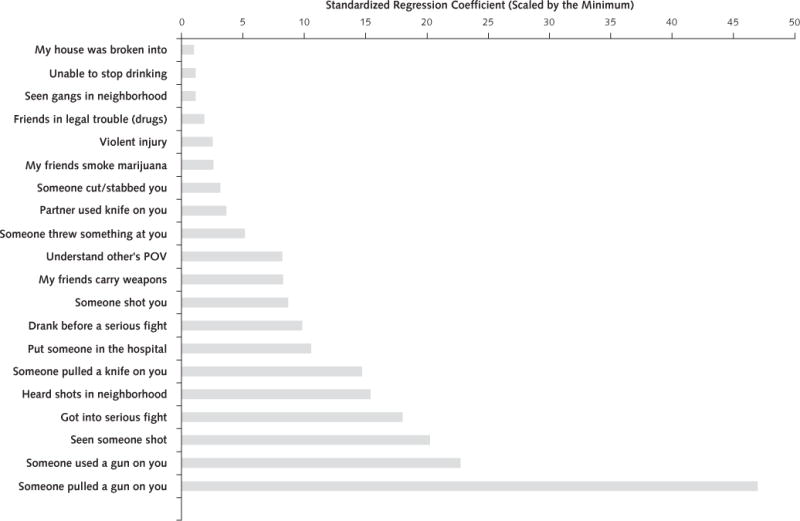
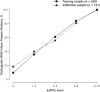
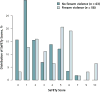
A total of 599 youths were enrolled, and presence/absence of future firearm violence during follow-up could be ascertained in 483 (52.2% were positive). The sample was randomly split into training (75%) and post–score-construction validation (25%) sets. Using elastic-net penalized logistic regression, 118 baseline predictors were jointly analyzed; the most predictive variables fell predominantly into 4 domains: violence victimization, community exposure, peer influences, and fighting. By selection of 1 item from each domain, the 10-point SaFETy (Serious fighting, Friend weapon carrying, community Environment, and firearm Threats) score was derived. SaFETy was associated with firearm violence in the validation set (odds ratio OR, 1.47 95% CI, 1.23 to 1.79); this association remained (OR, 1.44 CI, 1.20 to 1.76) after adjustment for reason for ED visit. In 5 risk strata observed in the training data, firearm violence rates in the validation set were 18.2% (2 of 11), 40.0% (18 of 45), 55.8% (24 of 43), 81.3% (13 of 16), and 100.0% (6 of 6), respectively.
Limitations
The study was conducted in a single ED and involved substance-using youths. SaFETy was not externally validated.
Conclusion
The SaFETy score is a 4-item score based on clinically feasible questionnaire items and is associated with firearm violence. Although broader validation is required, SaFETy shows potential to guide resource allocation for prevention of firearm violence.
Primary Funding Source
National Institute on Drug Abuse R01024646. -
Subjects:
-
Source:Ann Intern Med. 166(10):707-714.
-
Pubmed ID:28395357
-
Pubmed Central ID:PMC5697901
-
Document Type:
-
Funding:
-
Volume:166
-
Issue:10
-
Download URL:
-
File Type:
 [PDF - 319.90 KB]
 -
Collection(s):
-
Main Document Checksum:urn:sha256:2cf513d1b490c9325874e706c4fb33692266f82ebb1c27da26ee90d454d29ac7
Supporting Files


File Language:
English
 Was this page helpful?
 Found an issue?




CDC STACKS serves as an archival repository of CDC-published products including
scientific findings, journal articles, guidelines, recommendations, or other public health information authored or
co-authored by CDC or funded partners.
As a repository, CDC STACKS retains documents in their original published format to ensure public access to scientific information.
As a repository, CDC STACKS retains documents in their original published format to ensure public access to scientific information.
You May Also Like
COLLECTION
CDC Public Access