



Invasive Cancer Incidence — United States, 2010
Supporting Files
Public Domain

-
Mar 28 2014
Details
-
Journal Article:Morbidity and Mortality Weekly Report (MMWR)
-
Personal Author:
-
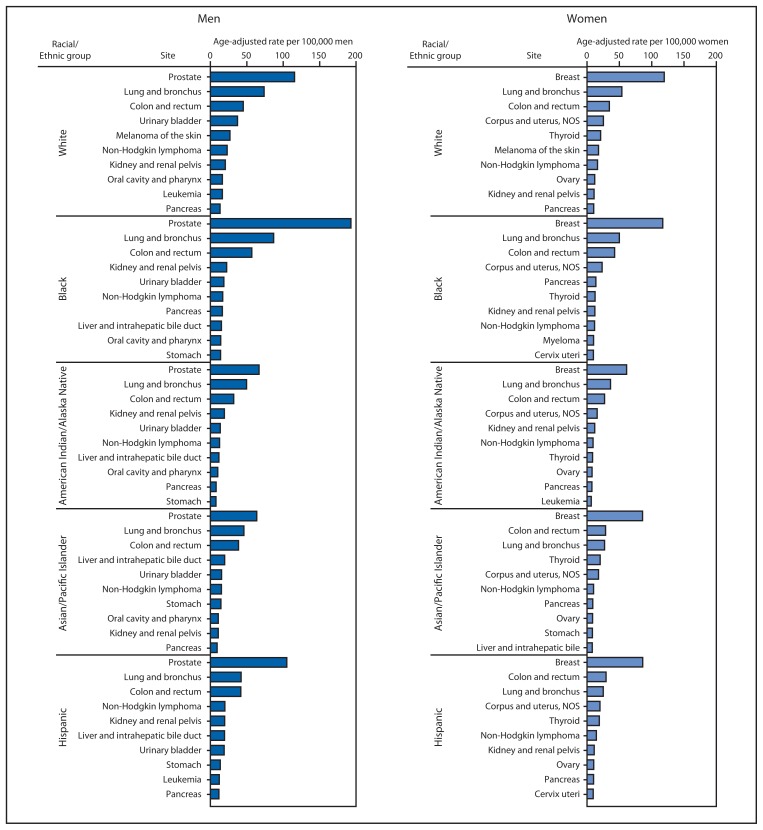
Description:Cancer has many causes, some of which can, at least in part, be avoided through interventions known to reduce cancer risk. Healthy People 2020 objectives call for reducing colorectal cancer incidence to 38.6 per 100,000 persons, reducing late-stage breast cancer incidence to 41.0 per 100,000 women, and reducing cervical cancer incidence to 7.1 per 100,000 women. To assess progress toward reaching these Healthy People 2020 targets, CDC analyzed data from U.S. Cancer Statistics (USCS) for 2010. USCS includes incidence data from CDC's National Program of Cancer Registries and the National Cancer Institute's Surveillance, Epidemiology, and End Results (SEER) program and Mortality data from the National Vital Statistics System (U.S.)In 2010, a total of 1,456,496 invasive cancers were reported to cancer registries in the United States (excluding Arkansas and Minnesota), an annual incidence rate of 446 cases per 100,000 persons, compared with 459 in 2009. Cancer incidence rates were higher among men (503) than women (405), highest among blacks (455), and ranged by state from 380 to 511 per 100,000 persons. Many factors, including tobacco use, obesity, insufficient physical activity, and human papilloma Virus (HPV) infection, contribute to the risk for developing cancer, and differences in cancer incidence indicate differences in the prevalence of these risk factors. These differences can be reduced through policy approaches such as the Affordable Care Act, which could increase access for millions of persons to appropriate and timely cancer preventive services, including help with smoking cessation, cancer screening, and vaccination against HPV.
-
Subjects:
-
Source:MMWR Morbidity Mortal Weekly Rep. 2014; 63(12):253-259.
-
Series:
-
ISSN:0149-2195 (print) ; 1545-861X (digital)
-
Pubmed ID:24670926
-
Pubmed Central ID:PMC5779349
-
Document Type:
-
Corporate as Subject:
-
Place as Subject:
-
Pages in Document:7 pdf pages
-
Volume:63
-
Issue:12
-
Download URL:
-
File Type:
 [PDF - 484.26 KB]
 -
Collection(s):
-
Main Document Checksum:urn:sha-512:6455e02905b25daa0b28cb898f4c4642ec3b1b74552911e504516813356ba34949c41e2ffc660cc3bef03fce561bd80e76706f7ae78c7c5bea377198d2ac75bd
Supporting Files


 Was this page helpful?
 Found an issue?




CDC STACKS serves as an archival repository of CDC-published products including
scientific findings, journal articles, guidelines, recommendations, or other public health information authored or
co-authored by CDC or funded partners.
As a repository, CDC STACKS retains documents in their original published format to ensure public access to scientific information.
As a repository, CDC STACKS retains documents in their original published format to ensure public access to scientific information.
You May Also Like
COLLECTION
Morbidity and Mortality Weekly Report (MMWR)